


The Farmer and His Hoe
I often find myself thinking about the invention of something as ordinary as the hoe.
Imagine a farmer, thousands of years ago, who spent much of his time preparing the soil with his hands or whatever rudimentary implements were available to him. Through observation, experimentation and a desire to improve how he worked, he fashioned a tool that allowed him to cultivate more land with less effort.
He could now produce more food with the same expenditure of time and energy. Other farmers, observing the improvement, would have had reason to adopt the tool. Someone particularly skilled at making it might eventually have found that manufacturing farming implements was a viable occupation in its own right.
From this relatively simple improvement, we can trace the emergence of technological innovation, increased productivity, economic surplus, specialisation and new commercial activity.
What interests me most about this illustration is the motivation at its origin. The farmer needed neither an innovation strategy nor an entrepreneurship programme. He understood a practical problem intimately and applied his ingenuity to improving how he worked.
Whatever technological sophistication we have attained as a species, this remains one of the fundamental mechanisms through which societies develop.
I wonder whether, in our contemporary pursuit of African entrepreneurship, innovation and economic development, we have given sufficient attention to it.
The Progress Industry
Over the past few days, several seemingly unrelated discussions on X caught my attention.
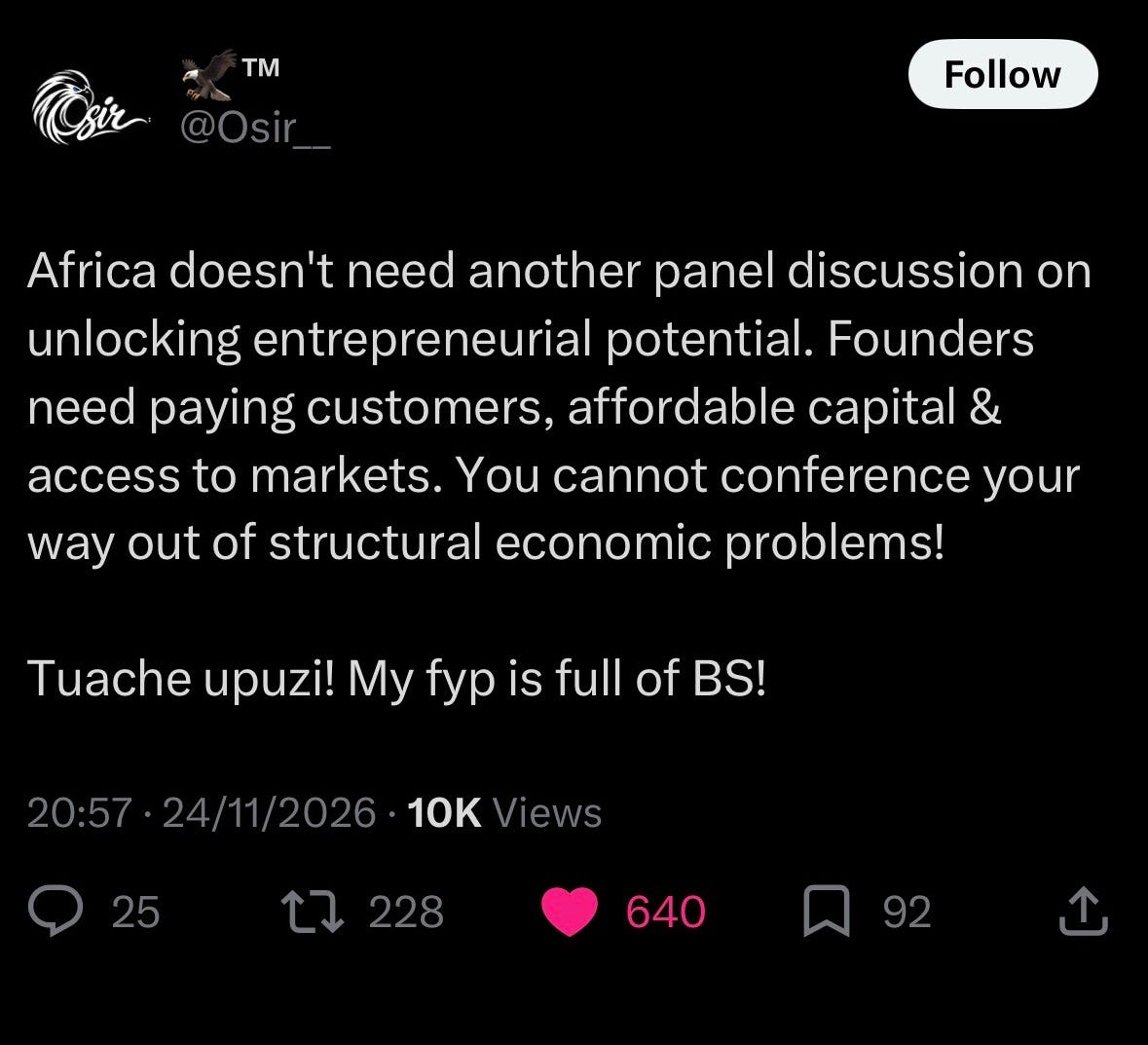
One expressed frustration with the proliferation of African entrepreneurship conferences, observing that founders need paying customers, affordable capital and access to markets.
Another questioned how much of the money committed to supporting small businesses actually reaches those businesses, as opposed to financing the activities of the organisations established to support them.
A third, by Temidayo Oniosun, suggested that entrepreneurs stand a better chance of becoming wealthy through conventional businesses than through startups.

There is a common thread running through these observations.
Over the years, an entire professional industry has developed around African entrepreneurship and economic development. It includes accelerators, incubators, consultants, development organisations, conference organisers, trainers and specialist media organisations.
Many perform valuable functions. Building a business amid limited access to capital, fragmented markets and inadequate infrastructure is difficult. Organisations capable of addressing these constraints deserve their place.
What warrants greater scrutiny is the relationship between the prosperity of this industry and the prosperity of the businesses it exists to support.
An organisation contracted to train 500 entrepreneurs could fulfil its contractual obligations, receive its fees and qualify for further funding without establishing whether those entrepreneurs subsequently built better businesses.
A conference organiser could increase revenue and attendance every year without knowing how much commercial activity previous editions generated for participants.
Under certain arrangements, the business of supporting entrepreneurship can become considerably more predictable and lucrative than entrepreneurship itself.
In 1990, the economist William Baumol published an influential paper, Entrepreneurship: Productive, Unproductive, and Destructive. His central argument was that the way societies channel entrepreneurial ingenuity depends substantially on the rewards they attach to different activities.
Where considerable money is available for administering entrepreneurship programmes, entrepreneurial people will naturally establish businesses to capture that expenditure.
The institutions supplying the money ought to be particularly interested in how much additional economic activity it generates beyond the organisations administering it.
That requires knowing what happened to the businesses six months, a year or several years after the workshop ended.
The Visibility Premium
There is another side to this problem that receives considerably less attention: the people and institutions responsible for allocating resources.
Imagine two Nigerian businesses with very different commercial and institutional profiles.
The first is a technology startup generating $300,000 in annual revenue and operating at a loss. Its founder has participated in several accelerators, regularly speaks at industry events, maintains an active LinkedIn presence and has been featured in prominent technology publications.
The second is a manufacturing business generating $3 million in annual revenue and $450,000 in annual profit. It employs dozens of people, has established distribution relationships across several states and has spent years refining its production processes. Its online presence consists of little more than a basic website.
An investment analyst sitting in an office in London, Washington, Johannesburg or Abuja is likely to discover the first business relatively easily.
Discovering the second may require visiting industrial estates, speaking to distributors, examining supply chains and spending time with people who understand the industry’s commercial dynamics.
Assessing it may also require more work. Its accounts might need improvement, its governance arrangements may be inadequate and its operations may be unfamiliar to the investment team.
The first business presents itself in a format that institutional processes are already equipped to handle.
I would describe this as the visibility premium: the advantage businesses enjoy in accessing capital and other opportunities because they are easier for institutions to discover, understand and assess.
Some of this advantage is deserved. Reliable accounts, effective communication, credible references and sound governance reduce the cost and risk of investing. A profitable business with poor governance or unverifiable financial records may be an entirely unsuitable investment.
But discoverability also matters.
A study of 885 institutional venture capitalists, published in the Journal of Financial Economics in 2020, found that professional networks generated over 30% of investment opportunities. Referrals from other investors accounted for another 20%, and existing portfolio companies accounted for 8%. Investors proactively sourced almost 30% themselves.
The quality and composition of an investor’s network can consequently have a significant bearing on the opportunities available to them.
An investment committee may exercise excellent judgement in assessing every business presented to it while remaining unaware of an entire category of potentially attractive investments.
The limitation in such circumstances lies in the discovery process.
Entrepreneurs, meanwhile, observe which of their peers receive funding, gain media recognition, join international delegations and acquire access to important institutional networks.
They adjust their behaviour accordingly.
If visibility improves an entrepreneur’s prospects of securing capital or commercial opportunities, investing time and money in cultivating that visibility is rational.
The resulting demand sustains conferences, publicity services, accelerators and other activities that generate much of the information subsequently consumed by resource allocators.
The process reinforces itself. Institutions reward visible businesses, entrepreneurs invest in visibility, and the industry surrounding entrepreneurship grows.
Capable operators outside this network may remain largely invisible to the institutions best positioned to support their expansion.
The implications extend to policymaking.
A government agency seeking to develop an industry might commission research, engage consultants and convene workshops attended primarily by people already within its institutional reach.
Some of the most useful knowledge about that industry, however, may reside with operators who have spent decades working within it and have rarely been consulted.
The economist Friedrich Hayek explored this problem in his 1945 essay, The Use of Knowledge in Society. Much economically valuable knowledge is dispersed among people whose familiarity with particular circumstances comes from experience.
The manufacturer who understands why imported equipment frequently breaks down under local operating conditions possesses knowledge that could materially improve industrial policy.
Obtaining that knowledge requires institutions willing to spend time where economic activity actually takes place.
The Economics of Building
I find the relative prestige afforded to technology entrepreneurship and conventional business ownership particularly interesting.
The distinction becomes particularly interesting when viewed through the economics of business ownership.
A founder owns 70% of a business with sufficient distributable profits and cash to pay $1 million in annual dividends. If those dividends are declared, the founder receives $700,000 before personal taxes.
Another owns 15% of a technology company valued at $100 million following its latest fundraising round. Applying the headline valuation to that shareholding produces a figure of $15 million.
How much the founder ultimately receives depends on a future sale or other liquidity event, subsequent dilution, the rights of other shareholders and what a buyer is willing to pay.
Both founders may be building valuable businesses. Their routes to personal wealth differ considerably.
Venture capital remains an important financing mechanism for businesses whose growth opportunities justify substantial upfront investment. It has enabled experimentation and rapid expansion on a scale that conventional financing would rarely accommodate.
For many businesses, however, retained earnings, patient equity and appropriately structured credit provide a more suitable route to growth.
This is especially relevant in African markets, where successive fundraising rounds can be difficult to secure, currency depreciation can erode investment returns and opportunities to sell private company shares are limited.
It is one of the reasons I find the camel model of entrepreneurship compelling. Camel companies are designed around commercial efficiency, resilience and the ability to continue operating through difficult economic conditions.
A camel can also become a unicorn. Operational resilience and enterprise valuation are separate characteristics, and a business can possess both.
An African company that increases its annual operating profit from $500,000 to $2 million over five years while maintaining healthy cash flows has achieved annual compound profit growth of approximately 32%.
I would like to see more of our commercial media and professional communities celebrate achievements of this nature with the enthusiasm routinely afforded to fundraising announcements.
The activities we celebrate influence the activities ambitious people choose to pursue.
Technology and Productive Capability
These principles extend to national development strategy.
Last week, President Cyril Ramaphosa led a South African delegation to Silicon Valley to explore opportunities arising from artificial intelligence.
The visit prompted criticism concerning the scale of South Africa’s technological ambitions relative to its economic resources and domestic infrastructure challenges.
Among the initiatives discussed was a proposed R100 million fund to improve local entrepreneurs’ access to computing infrastructure.
Ramaphosa also committed to developing a national AI action plan within 90 days. Interestingly, in his closing address, he expressly acknowledged the danger of establishing another institution that produces reports without results.
The success of the visit should ultimately be assessed against what South Africa subsequently achieves.
The United States’ capabilities in artificial intelligence draw upon decades of investment in scientific research, semiconductor engineering, universities, computing infrastructure and commercialisation.
African countries have considerable opportunities to apply existing AI technologies to agriculture, manufacturing, logistics, healthcare, financial services and public administration.
A manufacturer that uses artificial intelligence to reduce production costs by 15% and expand its exports is participating meaningfully in the AI economy.
Thousands of such improvements could materially change the competitiveness of an entire economy, while generating the technical experience, domestic demand and commercial returns required to support more sophisticated technological investments.
There is also a strategic case for developing and owning certain technologies and infrastructure, particularly where dependence on foreign providers introduces economic or security vulnerabilities.
The practical challenge is determining where to deploy scarce resources today while building the capabilities required for tomorrow.
The Organised Productive Minority
I have long been interested in the implications of elite theory for economic development, particularly the work of Vilfredo Pareto and Gaetano Mosca.
Pareto’s observations concerning the concentration of economic outcomes, and Mosca’s emphasis on the influence of organised minorities, provide a useful perspective on Africa’s development.
A World Bank analysis published in July 2026 highlighted an extraordinary feature of African enterprise. Of an estimated 244 million businesses, approximately 95% consist solely of their owners.
Despite the sheer volume of entrepreneurial activity across the continent, relatively few businesses develop the capacity to employ substantial numbers of people.
Yet there are pockets of considerable productive capability.
There are farmers who have developed effective cultivation methods, manufacturers operating efficiently under difficult conditions, traders who have constructed sophisticated distribution networks and engineers who have found commercially viable solutions to infrastructure problems.
There are also investors, financiers and other professionals capable of connecting these operators to the resources they require.
What could we achieve by identifying and organising these concentrations of capability more effectively?
An agricultural processor, for instance, might be producing 1,000 tonnes annually despite having commercially viable demand for 2,500 tonnes. Its management has demonstrated its operating capabilities, but unreliable electricity, insufficient working capital and inadequate storage prevent expansion.
Addressing those constraints could increase production by 150%.
The resulting expansion creates opportunities for farmers supplying raw materials, logistics companies, equipment suppliers, maintenance technicians and financial institutions.
Employees acquire skills and experience that may eventually enable some of them to establish businesses of their own.
A relatively small group of coordinated individuals can initiate economic activity in which thousands of other people subsequently participate.
This is how concentrated productive capability can translate into widely distributed economic opportunity.
The quality of that coordination matters considerably. Well-connected groups can equally use their influence to restrict competition, secure preferential access to public resources and protect inefficient businesses.
Institutions must therefore reward demonstrated capability while preserving opportunities for new participants to emerge. Productive elites should prosper through expanding the economic opportunities available to others.
A Different Approach to Development
There is already evidence of what carefully designed interventions can achieve.
Nigeria’s YouWiN! business plan competition identified promising entrepreneurs and provided grants averaging $50,000. A 2017 evaluation found that the grants improved business formation, survival, sales, profits and employment. Winning increased the likelihood of operating a business with at least ten workers by more than 20 percentage points.
More recent evidence from Kenya’s MbeleNaBiz programme is particularly instructive.
Research published in 2026 found that $9,000 grants awarded through a more rigorous selection process produced more sustained employment gains than identical grants awarded through a streamlined process.
After three years, the employment effects of grants four times larger were statistically indistinguishable from those of the smaller grants awarded through the rigorous process.
The researchers estimated that reallocating the same grant budget towards smaller grants for similarly selected entrepreneurs could have supported approximately 3,042 additional jobs, compared with the 1,313 actually sustained after three years.
The quality of selection and the suitability of the funding mattered enormously.
This has practical implications for African development institutions.
Investors can broaden their sourcing networks through relationships with distributors, equipment suppliers, industry associations and experienced operators.
Governments can develop industrial policy around direct engagement with businesses, identifying the constraints that prevent demonstrated productive capabilities from expanding.
Development organisations can report how much funding reaches enterprises, the cost of administering their programmes, and the additional sales, profits, productivity and sustained employment their interventions generate.
The same discipline should extend to conferences, trade missions and entrepreneurship programmes. Their value can be assessed through commercial relationships established, transactions completed, capabilities developed and other outcomes that justify the resources devoted to them.
There will always be an important role for experimentation, scientific research and the financing of ideas whose commercial potential has yet to be established. Development requires the discovery of new capabilities as well as the expansion of existing ones.
I suspect, however, that some of Africa’s most promising economic opportunities are already visible to the people working on factory floors, farms, construction sites, trading routes and distribution networks across the continent.
Somewhere on the continent today, there is almost certainly a modern equivalent of that farmer, quietly refining how something is produced, distributed or delivered.
He may have little familiarity with the language of innovation. He may never have attended an entrepreneurship conference. He may have no idea how to approach the institutions with the resources to help him expand what he does.
Finding him, understanding what he has achieved and helping him do considerably more of it should occupy a greater proportion of our collective development efforts.