

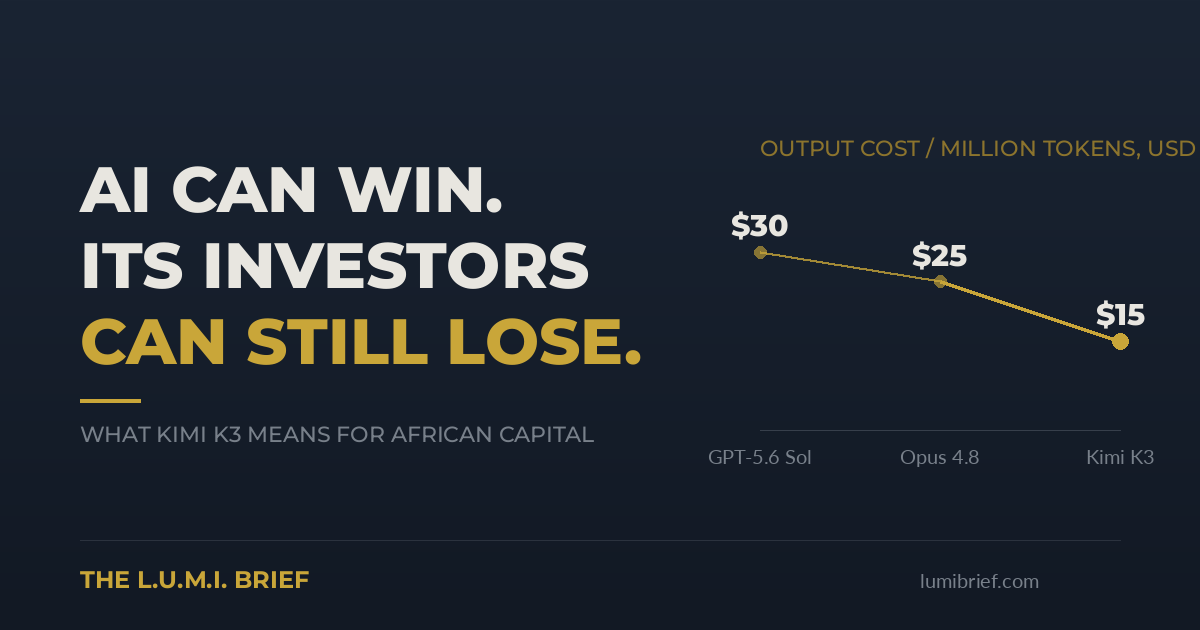
Kimi K3 charges $3 per million input tokens and $15 per million output tokens. GPT-5.6 Sol charges $5 and $30. Claude Opus 4.8 charges $5 and $25. K3 is an open-weight model from a Chinese lab most Western allocators had never heard of eighteen months ago, and its full weights aren’t even public yet: Moonshot won’t release them until July 27. It’s already undercutting both US flagships on price, sharply on the output side, while ranking fourth among all frontier models on independent benchmarks, behind only Claude Fable 5 and GPT-5.6 Sol itself, and ahead of Claude Opus 4.8. That capability is coming out of a lab operating at a fraction of the capital base American labs have spent building the infrastructure behind their own models.
Reflect on that gap before anything else. It matters less as a fact about Kimi K3 and more as evidence about the story everyone else has been telling.
The bet underneath the bet
Start with what’s really being financed. The big four hyperscalers are on track to spend somewhere between $600 billion and $700 billion on AI infrastructure in 2026 alone. Chips, data centres, power generation, grid capacity. Up from roughly $400 billion the year before. Goldman Sachs puts the 2025 to 2027 hyperscaler capex cycle north of $1.1 trillion.
Capital intensity has crossed 45 to 50% of revenue for some of these companies, a ratio that used to belong to utilities and heavy industry, not software firms. Debt issuance to fund it is projected at $1.5 trillion over the next few years, because none of this can be paid for out of cash flow anymore.
That capital base only makes sense if AI stays hard enough, expensive enough, and proprietary enough that whoever spends the money to reach the next capability tier can charge for the privilege before everyone else catches up. AI already works. That part of the bet is settled. What’s still open is whether working AI stays scarce enough to be worth what was paid to build it.
This is not a new kind of mistake. Railways rewired entire economies in the nineteenth century and still bankrupted most of the companies that built them. Overbuilding and rate wars pushed freight and fares down for shippers and passengers: real consumer surplus, genuinely valuable. The operators competed away their own margins funding the capacity that made those low prices possible, and went into receivership doing it. A large share of the companies that built the internet suffered the same fate. A technology can be a total success and still be a bad place to have parked your capital, because success and captured value are two different questions with two different answers.
What Kimi K3 really threatens
Chinese AI labs have been closing the capability gap for a while. DeepSeek’s release in January 2025 wiped $590 billion off Nvidia’s market cap in a single trading day, and that was a much smaller model than K3. What’s different about K3 is that it isn’t cheap in the way earlier Chinese models were cheap. It’s priced close to the frontier, performing close to the frontier, and going out the door as open weights, free for anyone to download, host, and build on. But at 2.8 trillion parameters, K3 is not something a developer runs on a laptop. So, what it realistically enables is a commodity hosting layer: any cloud provider or inference host can run it and sell access, without paying Moonshot anything for the privilege.. That’s a different kind of threat than “China builds a discount version.” It’s “China removes the thing you were charging for.”
Dean Ball called open-weight releases “inherently decelerationist” this week, and he’s half right in an interesting way. Ball is head of strategic futures at OpenAI, having just left the White House, where he was the chief drafter of America’s AI Action Plan. That makes him an unusually well-placed observer, and also someone whose employer holds the single largest financial stake in frontier-model scarcity staying intact. He’s decelerating the wrong thing. What open models slow down is the return to the private capital that financed frontier development. What they accelerate is how fast that capability spreads to everyone else, including the enterprises and developers who no longer need to pay a premium to a US lab for something a free download does almost as well. Ball himself admits he’s puzzled why Beijing allows models this capable to leave the building for free. The likeliest answer isn’t ideology. A lab with a computing disadvantage, competing against companies with better chips and more of them, doesn’t win by matching the leader’s price. It wins by undercutting it, hard enough that the leader’s price stops mattering.
That’s a specific and legible strategy, not confusion or generosity. If Chinese firms keep publishing capable models as free downloads on Hugging Face and equivalent repositories, they give up direct rent on the model layer, the actual software doing the thinking, in exchange for something more durable: faster domestic AI adoption, less Chinese dependence on American providers, and a shift in where the economic value settles, toward the manufacturing, robotics, energy hardware, and physical deployment layers where China already has stronger positions than it does in chip design. America is trying to own intelligence. China’s strongest AI labs are behaving as if the better trade is making intelligence too cheap to own.
There’s a real counterargument here, and it deserves a paragraph rather than a footnote. Jevons paradox says cheaper inputs can cause total consumption to rise faster than the price falls. Cheap intelligence could make demand explode so completely that aggregate compute spending keeps climbing even as the price per unit of intelligence collapses. In that world, model margins compress, but Nvidia, the power companies, and the data centre operators still do extremely well, because someone still has to run all this compute regardless of who wrote the software. That distinction matters for anyone pricing this risk. The exposure isn’t uniform across the AI stack. It’s concentrated at the model layer, where the pricing power was always going to be hardest to hold onto.
That same concentration cuts the other way for a different set of people. An African founder running AI workloads has spent two years paying dollar-denominated API margins to a US lab, on top of naira or cedi revenue and every other FX squeeze already on the P&L. Once K3’s weights are public on July 27, and as more near-frontier open-weight models follow the same path, self-hosting or routing to a cheaper open-weight backend becomes a live option for workloads that used to require a frontier API call. For a founder whose AI spend is a meaningful share of monthly burn, that’s a real opex line moving in the right direction. The exact size of the saving depends on the workload and the founder’s own numbers, but it’s the kind of compression that buys extra runway without cutting anything else. The sharper implication sits underneath that saving, though. Founders who built “AI-powered X” and treated API access itself as the differentiator now have a shrinking moat, because the thing they were charging a premium for is becoming a commodity faster than most expected when raising their last round. What was defensible eighteen months ago, access to good-enough intelligence, is turning into table stakes. Defensibility has to move to data, distribution, or workflow lock-in that a cheaper model can’t replicate just by existing.
Where this lands on African capital
This is the part that turns it from a Silicon Valley story into a LumiBrief one.
Call it the Capital Transmission Mechanism: global liquidity conditions set by US monetary policy, US risk appetite, and US capital markets don’t stay contained to US portfolios. They move downstream into how much capital DFIs, pension allocators, and global LPs are willing to commit to frontier markets, and how fast. When US financial conditions tighten, African fund commitments tighten with a lag, not because anything changed on the ground in Lagos or Nairobi, but because the LP sitting in New York or Brussels just got more conservative.
I traced this mechanism directly earlier this year, when Iran-war shock psychology helped drive an 87% collapse in African VC fundraising that had almost nothing to do with African fundamentals. Series A volume down 69% year-on-year. Series B rounds essentially at zero. Equity’s share of deal value falling from 76% to 43% while DFI-backed debt rose 165% to fill the gap. The trigger was a war half a continent away from any of the companies whose funding rounds it shrank. The mechanism doesn’t care what triggers it. A war, a rate shock, a US tech repricing: they all move through the same pipe.
A model-layer repricing in US AI equity is a plausible trigger of exactly that kind, and it moves through more than one channel. The most direct one is risk appetite. If investors start pricing in what K3 implies, that the AI capex bet assumed a durability of returns a fast-improving open-weight competitor is actively eroding, a correction in AI-linked tech valuations doesn’t need to be catastrophic to matter. A 15 to 20% repricing across the AI-heavy names carrying an outsized share of US market capitalisation would be enough to tighten the risk appetite DFI investment committees weigh before approving a next fund’s first close or re-upping into a new vintage. DFIs move on US macro signal faster than commercial LPs do, because their mandates are built around exactly this kind of systemic-risk sensitivity.
The second channel runs through the currency, and it’s the one allocators tend to underweight. Tighter US financial conditions generally mean a stronger dollar, and a stronger dollar is bad news for the naira, the cedi, the shilling, and every other African currency already managing its own pressures. A US equity repricing large enough to tighten LP risk appetite is also, most likely, a US equity repricing that comes with dollar strength, which squeezes African portfolio companies on imported costs and debt service at the same time their funders are getting more cautious. The two channels reinforce each other instead of running independently.
None of this requires African GPs to have any AI exposure at all. The transmission doesn’t run through African portfolios. It runs through the LPs deciding whether to commit to the next fund, through the currency their portfolio companies transact in, and through to founders too, further downstream: a slower cycle of new fund closes means fewer priced rounds and smaller checks in the exact window a founder is trying to raise, regardless of what their own numbers look like.
The practical implication isn’t “watch AI stocks” as a general instruction. Everyone already does that badly. It’s narrower. GPs currently in fundraise should treat a US AI-equity repricing event as a leading indicator for LP commitment timing, arriving faster than most African macro data would suggest and independent of anything happening in the underlying African economy. The variable worth watching isn’t whether AI works. It’s whether the companies that financed it get paid back on the timeline their capital structures assumed, because when that question gets repriced in New York, the answer shows up in Accra and Nairobi a quarter or two later, in the form of a slower first close.
The AI investment thesis and the AI technology thesis have quietly come apart from each other, and most allocators are still pricing risk as if they’re the same question. They aren’t. One asks whether artificial intelligence will create enormous economic value. It probably will. Kimi K3 is itself proof the technology keeps getting more capable, more available, and cheaper to access. The other asks whether the specific companies that borrowed $1.5 trillion to build it will be the ones who get paid. Those are different bets, and an allocator who has only priced the first one is carrying risk they haven’t named.
The greatest threat to the AI investment boom was never that AI would fail. It’s that intelligence becomes abundant before its financiers get paid back, and that bill doesn’t stay in Silicon Valley. It travels through the same liquidity pipes that already decide, every quarter, how much capital reaches a fund closing in Lagos.
If you’re in a fundraise this year, or sitting on an LP commitment decision, this is worth watching more closely than the headlines suggest. I’ll be tracking it.
Hmm, sobering take on the unfolding AI story. I'm no investor, but if this AI bubble bursts it will have a widespread fallout.
As a self-styled AI consultant, I actually find the technology risk o more concern. The bet is that AI will produce intelligence cheap enough to replace labor, and I'm not sure it will. I am buying the present skepticism. Token costs are still heavily subsidized by investors or companies spending on experimental rollouts, with a lot of financial engineering on the part of model providers going on to justify fundraising.
Because of that, I'm inclined to caution clients not to bet their economics on AI substituting human inteligence. I'd rather sell organizational development than "AI transformation”