


An IPO naturally draws attention to valuation. What is the business worth, how fast can it grow, and what might investors earn? Anthropic’s proposed listing raises another question worth examining closely: who gets to decide what the company does? That is the substance of governance. It determines who makes decisions, who can block them, who holds decision-makers accountable and how disagreements are resolved. For a company developing powerful AI, those arrangements can shape which products reach the market, what risks are accepted and how commercial demands are weighed against safety commitments. Investors are buying into a business whose decisions could affect far more people than its shareholders. Its governance deserves scrutiny alongside its valuation.
Anthropic’s founders can hold majority shareholder voting power while a separate trust appoints a majority of its board. Both descriptions can be accurate. Neither, on its own, tells you who can get a particular decision through.
That was what stayed with me after listening to this episode of Market Maker. It is a great podcast, and its discussion of Anthropic’s proposed IPO structure provided the seed for this piece.
The structure invites a familiar reaction: several share classes, a founder vehicle, a mission-oriented trust and another approval procedure for one board seat. Plenty to keep the lawyers occupied.
But each layer allocates something consequential. Who participates financially? Who votes? Who appoints directors? Whose agreement is needed when the people involved want different things?
The answer to “who controls the company?” becomes useful when it identifies the decision, the necessary coalition and the procedure that applies if that coalition cannot agree.
The shares distribute different rights
The arrangements described here come from Anthropic’s preliminary October 26, 2026 IPO filing and accompanying governance documents. They remain subject to change. In outline:
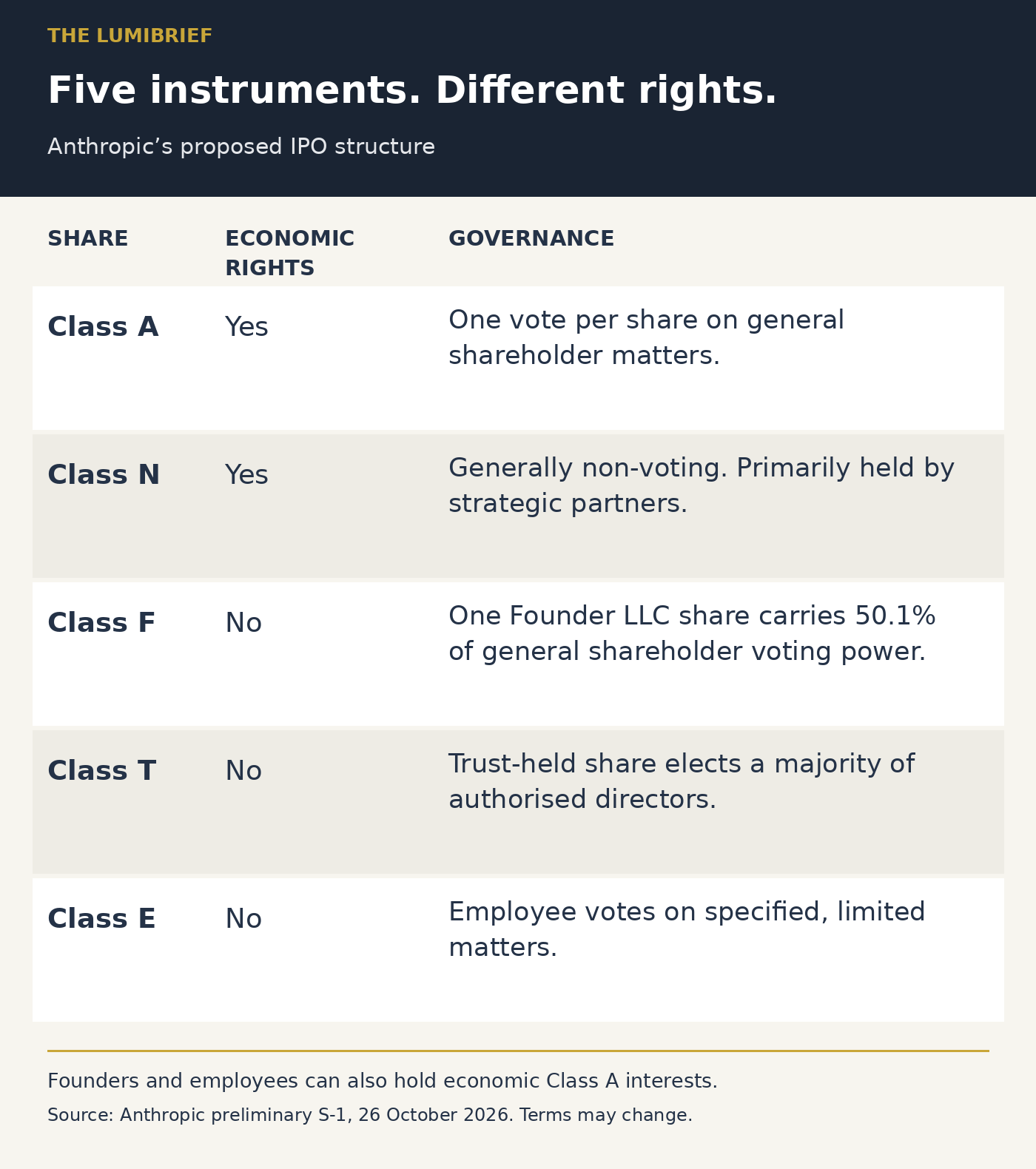
Economic interests and governance rights sit in different instruments. Proposed terms, subject to change.
The founders also hold Class A interests, and employees can receive Class A equity awards. Their financial participation sits alongside the special governance instruments. The Class A offered to public investors is therefore not an exclusively retail class. [1]
That distinction matters when reading any capital structure. A person can hold several instruments, each doing a different job. Describing one instrument as non-economic does not mean its holder has no financial stake.
It also means an investor’s financial exposure and influence need separate examination. A claim on the company’s value does not necessarily carry the votes needed to change its direction. Whether that bargain is attractive depends on the rights, price and investor’s objectives.
The mission obligation leaves room for judgment
Anthropic is already a Delaware public benefit corporation, or PBC: a for-profit corporation whose board must balance shareholders’ financial interests, the interests of people materially affected by its conduct, and its stated public benefit. The law does not automatically give the mission priority in every conflict. [2]
That creates a duty requiring judgment. It does not prescribe Anthropic’s particular share classes or trust arrangement.
OpenAI offers a useful comparison. Following its reorganisation, its commercial business is OpenAI Group PBC, while the nonprofit OpenAI Foundation retains special rights to appoint and replace the Group’s directors. The commercial entity’s form and the identity of its controller are separate questions. [3]
Two companies can therefore share the PBC designation and allocate authority differently. The designation tells us something about the obligations under which decisions are made. We still need the governance documents to establish who participates in making them.
Majority voting power does not supply every approval
Anthropic’s proposed arrangement contains two principal sources of governance authority. The founders’ shareholder vote operates alongside the trust’s right to elect a board majority. On a seven-seat board, that majority is four seats. [4]
Consider an illustrative transaction at a company with this broad division of powers. Assume its documents and applicable law require both board approval and a shareholder majority for a proposed sale.
A founder coalition might deliver the shareholder approval. That does not supply the board resolution. Conversely, a board might support the sale while the necessary shareholder approval remains unavailable.
The parties must secure agreement in both places.
This does not mean the directors are delegates who must follow instructions from whoever appointed them. Appointment rights influence who exercises board judgment; the directors still exercise that judgment under their duties. Treating four appointment rights as four guaranteed votes would skip a critical legal distinction.
Nor should we casually cast founders as the commercial camp and trustees as the mission camp. The filed Founder LLC agreement itself includes mission-related purposes. [5] Groups can share an objective and disagree over the risks, timing or acceptable means of pursuing it.
My reading is that the structure makes some forms of cooperation consequential. Whether that produces useful restraint or costly delay depends partly on the decision and the quality of the people making it.
For an investor, that is a more informative assessment than attaching a single “founder-controlled” label to the business.
The disagreement rules redistribute influence
Collective control has its own internal governance.
Under the filed Founder LLC agreement, members give instructions on voting the Class F share. A matching majority instruction generally determines its vote. If no such majority forms, the share generally follows the proportions of Class A votes cast, subject to the specified quorum and voting procedures. [5]
One dissenting founder therefore does not, by itself, defeat majority agreement. But collective control is conditional on the group producing the required instruction.
The fallback is particularly revealing. Failure to form a majority does not simply leave an unanswered instruction. The documents specify another basis for casting the vote. Influence can shift without a share changing hands.
There is another example at board level. For one specified trust-appointed seat, nomination, removal without cause or a change in designation requires nominating committee approval or the relevant Class E approval. If the committee does not approve, the matter can proceed to the employee voting route, unless withdrawn. The specified seat completes the trust’s four-seat majority on the seven-seat board. Requiring nominating committee concurrence, with an employee vote available if concurrence is withheld, gives those groups a say over that crucial appointment. The trust’s majority appointment right therefore operates with a check on the seat that makes it a majority. [4]
The distinction between an absolute veto and an objection that sends a proposal to another electorate is substantial. One can terminate the route to approval; the other changes who must be persuaded.
These provisions are part of the distribution of power. They determine what happens when the initial decision-making arrangement cannot produce agreement.
A governance review should therefore examine the fallback with the same care as the headline right. A majority, veto or appointment entitlement is only part of the analysis until we know the conditions for exercising it and the consequences of failure.
One shareholder entry can contain another governance system
The Founder LLC adds a further layer: a collective body sits behind a single registered holding.
I have used intermediate holding companies in structuring a venture-building programme, through which founders held interests in underlying operating companies. A useful feature of that approach is continuity: permitted changes among participants can be accommodated within a vehicle that remains the shareholder below.
The purposes are not identical. In Anthropic’s case, the vehicle holds a special voting instrument. The shared design principle is placing a collective arrangement behind an entity that can continue despite changes among its participants.
Used appropriately, this can reduce repeated changes at operating-company level. It also relocates questions that still need answers.
Who directs the vehicle’s vote? What happens when a participant leaves? Can interests pass to successors? Which changes require another participant’s consent? What could dissolve the vehicle or end its rights?
The shareholder name can remain stable while the people able to direct it change.
There are three things to distinguish: the registered shareholder, the participants’ financial interests and the authority to cast the shareholder’s vote. A change in one need not produce an identical change in the others.
The vehicle does not make every internal change consequence-free. Depending on the governing documents, upstream changes may still trigger consent, disclosure or transfer requirements. Continuity is a design benefit whose limits need to be understood.
For a GP reviewing a portfolio company, this means following a significant holding at least one level further. If a vehicle holds a decisive vote, its internal agreement may contain the provision that determines whether the next transaction can complete.
Complexity earns its place by resolving a real conflict
There are legitimate reasons to separate these rights. A company may want to raise capital, preserve continuity of leadership, protect a long-term purpose and give employees a defined voice. Those commitments do not necessarily require identical rights for everyone.
The assessment should examine what each additional layer achieves and what it costs.
A separate approval can prevent a consequential decision from being taken too easily. It can also delay a necessary decision. Collective voting can prevent one individual from acting alone. It can also leave the group unable to act. A holding vehicle can simplify administration while concentrating attention on an internal agreement that outsiders rarely inspect.
None of those consequences can be judged merely by counting share classes.
The further question is who can alter the arrangement itself. A safeguard’s durability depends partly on the conditions for amending, redeeming or terminating the rights that support it. Those provisions belong in a serious review even where the immediate transaction concerns something else.
Formal authority also operates alongside practical dependence. Access to financing, indispensable suppliers or key personnel can affect bargaining strength without creating an additional shareholder vote. Those dependencies should be assessed separately, rather than treating a non-voting holding as proof that its holder has no influence of any kind.
A delayed approval has a financial cost
The application for an African venture portfolio need not involve copying Anthropic’s structure. It involves using the same discipline to examine a financing or exit.
Take a clearly hypothetical scale-up with $1.2 million of unrestricted cash and net cash outflow of $300,000 a month. On those simplified assumptions, it has four months of runway. A proposed financing requires board approval and consent from a founder holding vehicle. The board supports it, but the vehicle’s participants cannot produce the required instruction.
If resolution takes two months and the cash assumptions remain unchanged, $600,000 is consumed while approval remains outstanding. Only two months of runway remain.
That arithmetic does not predict the financing terms or prove that the consent right was badly designed. It identifies the cost of time. The company has less room to withstand another delay or reject an unattractive proposal.
The pressure becomes especially relevant where replacement funding cannot be assumed. The governance question and the liquidity question meet at the approval still missing.
A useful pre-transaction review can record four things for each consequential decision: the required approvals, who can deliver them, the procedure if agreement fails, and the time available to resolve the problem. It should distinguish a negotiable objection from a legal bar, and a documented fallback from a hope that everyone will eventually cooperate.
That exercise gives the GP, founder and board something concrete to work with before cash pressure narrows their choices.
At the next financing or exit review, ask for the approval path alongside the cap table. Follow any decisive holding vehicle through its internal voting rules. Identify the consent that remains unavailable and the procedure for obtaining it.
That is the point at which a description of ownership becomes an assessment of whether the transaction can actually close.
Sources
Anthropic preliminary Form S-1, October 26, 2026, cover; Management; Principal and Selling Stockholders; Description of Capital Stock. Proposed terms, subject to amendment.
Filed form of Anthropic amended and restated certificate of incorporation, Exhibit 3.3, particularly Article VII. Board size is described in the S-1.
Filed form of Anthropic Founders, LLC agreement, Exhibit 99.2, particularly §§3 and 14. Simplified account of voting procedures; special matters have additional provisions.