

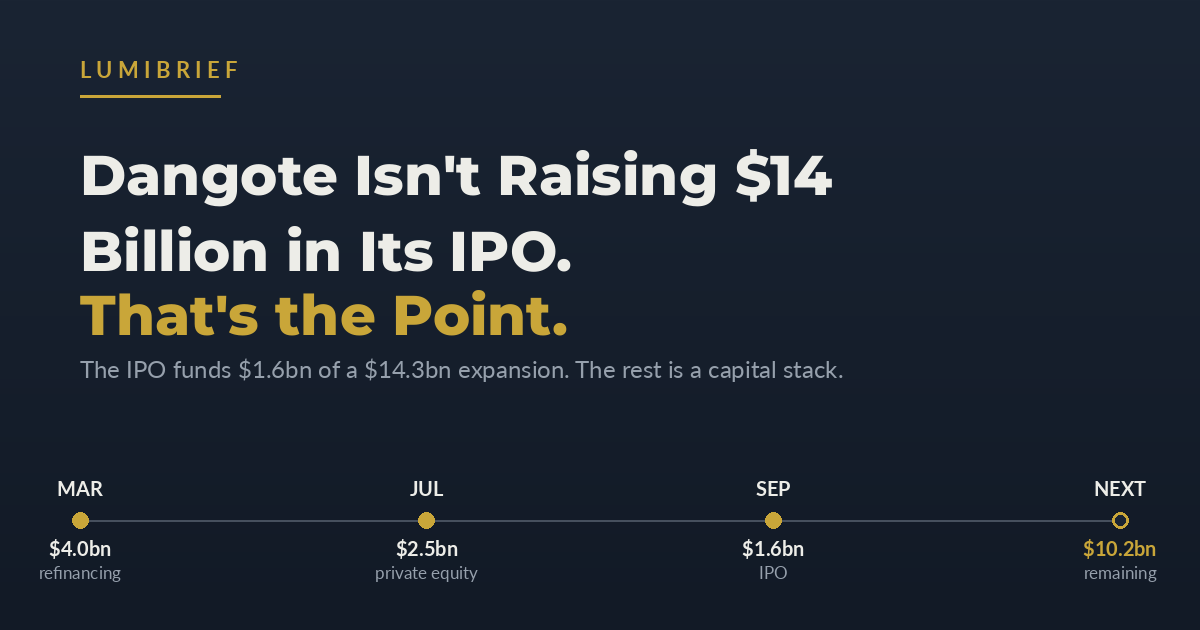
This past week, Dangote Petroleum Refinery and Petrochemicals opened what will likely become Africa’s largest share sale. 4.1 billion shares, ₦525 apiece, a target of ₦2.15 trillion, roughly $1.6 billion. Ten million Nigerians have been invited to buy in, from ₦5,250 upward, through 55 different apps and banks and brokers. It was being sold, correctly, as a landmark. It is also being read, incorrectly, as the financing.
The refinery has committed to a $14.3 billion expansion, doubling capacity from 700,000 to 1.4 million barrels a day by 2029. Subtract the IPO. Subtract the $2.5 billion private placement that closed in July, which Dangote’s own statement said would fund “the continued expansion” of the same complex. What’s left is about $10.2 billion, and nobody at the signing ceremony pretended otherwise. The prospectus says the balance comes from future profits, more loans, and project financing still to be arranged.
So the IPO isn’t solving the funding gap. It’s one entry in a ledger that’s been running since March.
Three capital events, six months, one expansion
Start with the sequence, because the order tells you more than any single number does.
In March, Afreximbank underwrote $2.5 billion of a $4 billion syndicated loan, with Access Bank as co-arranger. Afreximbank’s own release is specific about what this money did. It consolidated existing financing and optimised the capital structure, tidying up debt that predated the expansion announcement, much like refinancing a mortgage before asking the bank for a second loan on a new extension.
In July, Africa Finance Corporation led a $2.5 billion private placement, the refinery’s first equity raise to bring in owners beyond the Dangote family and its existing partners, oversubscribed 3.7 times. This is where the expansion money actually starts showing up on the balance sheet. Both AFC and Dangote said so directly, describing the proceeds as earmarked for the ongoing build-out and for strengthening the company’s capital structure.
In September, the IPO. Same expansion, different instrument, different investor base entirely, this time retail and public rather than institutional and private.
Three capital events. Three different sets of people providing capital. Three different sets of rights attached to that money. And still $10.2 billion short of the number Dangote needs.
There’s a fourth line in that ledger that doesn’t involve outside investors at all: the refinery’s own profit. It earned $1.82 billion after tax in the first six months of 2026, after losing $476 million across all of 2025. That makes future earnings a credible source of expansion capital, and it’s why the prospectus treats “future earnings” as a real financing line rather than a placeholder. But profit is not the same thing as cash available to build. Debt still has to be serviced, the existing refinery has to be maintained, working capital has to be funded, and shareholders may expect dividends. For the investors buying in this month, that creates a simple trade-off. Every dollar the refinery retains to help finance the expansion is a dollar that doesn’t get distributed to shareholders today.
The sequencing wasn’t only about raising money, either. Total indebtedness fell from $6.24 billion at the end of 2025 to $5.67 billion by June 2026, even as the company refinanced its borrowings through the March syndication. That matters because the IPO followed several months of deliberate balance-sheet restructuring rather than arriving as an isolated capital raise.
Read the $10.2 billion gap as failure and you’ve misread it. Read it as sequencing and the picture sharpens: Dangote is not financing a $14.3 billion expansion with an IPO. It’s financing it with a capital stack, one layer at a time, and the IPO is simply the layer that happens to be public.
Who’s actually holding what
The three instruments are not interchangeable, and the plain-English version of what each one means matters more than the acronyms.
The March loan is debt. Afreximbank and its syndicate lent money and expect it back, with interest, on a schedule, over five years. They don’t own any part of the refinery, and they don’t participate directly in its upside. They’re promised principal and interest instead. Their protection comes from contractual rights, security and covenants, and if the company struggles to pay, those protections determine how much leverage the lenders actually have.
The July placement is equity. AFC and the other new investors now own a slice of the company. They don’t get repaid on a schedule; they get paid if and when the refinery generates returns worth distributing, or if their shares are worth more later than they paid for them. In exchange for that patience, they take on the downside directly. If the expansion disappoints, their stake is worth less. Nobody owes them a floor.
The September IPO is also equity, but a different flavour of it. The checks are smaller, the set of owners is much larger and more dispersed, and the listing makes those shares tradeable on the Nigerian Exchange going forward. The important difference is what happens once the shares are listed: public-market investors have an organised market through which they can try to sell their shares, rather than having to find and negotiate directly with a private buyer. That doesn’t guarantee liquidity or a particular exit price, and AFC’s own shares may become tradeable too once listing conditions and any lock-ups are satisfied, but it materially changes the route to an exit for whoever holds the stock.
None of the three groups is financing “the IPO.” All three are financing the refinery, on different terms, at different points in its life, bearing risk in different proportions. That’s what a capital stack means in practice, not as an abstraction but as three sets of people who put in real money and will be treated differently if things go well or badly.
Think of it as three people putting money into the same building project at different stages, with the building still going up rather than finished. The bank lends against the plans and the plot, and wants its interest paid whether the building turns out beautiful or plain. The first private buyer pays while the walls are still going up and gets a proportionate share of whatever the finished building is worth. The retail buyer coming in now buys a smaller stake at a fixed, public price, on a building that’s still under construction, with the comfort of being able to try to resell that stake on a listed market rather than being stuck waiting for a private buyer. Same building, three different deals, and none of them cancels out the fact that the building still needs its roof paid for.
What listing actually buys, and what it doesn’t
This is the part of the argument where it’s easy to overreach, so the claim needs to be stated carefully.
Going public does not make Dangote’s future borrowing cheaper by itself. A bank underwriting the next tranche of project finance is going to look at what the refinery earns, how much debt already sits on it, whether the crude supply holds up, and what happens to margins if fuel prices move against them, long before it looks at the share price on the NGX. Cash flow and collateral carry that conversation, not a stock ticker.
What listing does buy is a different kind of access. A market-quoted price that updates every trading day. Disclosure obligations that didn’t exist when the company was privately held, which means more information reaches lenders and investors with less friction. A much larger potential pool of investors than private placements typically reach. And a standing route back to public investors, should Dangote want to raise equity this way again, that a private company simply doesn’t have on tap.
Those things sit alongside the relationships Dangote already has with Afreximbank, AFC, and the banks in the March syndicate; they don’t replace them. When Aliko Dangote mentioned, at the signing ceremony, that UAE’s ADNOC has expressed interest in investing “alongside others,” he was describing exactly the kind of conversation a listed company makes easier, not because the listing makes ADNOC’s money cheaper, but because it makes the company easier to evaluate and easier to negotiate with for anyone deciding whether to join the stack.
It would be tempting to treat the “IPO for the people” framing as marketing sitting on top of the real financing story. That’s the wrong read. Ten million targeted subscribers, distribution through 55 intermediaries including Flutterwave, MTN MoMo, Airtel Smartcash and Moniepoint, a ₦5,250 minimum ticket. This is a genuine attempt to widen who owns a piece of the country’s biggest industrial asset, and it sits comfortably next to the financing logic rather than competing with it. Dangote gets both things from the same transaction, and there’s no need to pick one explanation over the other.
For the ten million people this offer is aimed at, the practical question isn’t whether Dangote is being clever about its capital stack. It’s whether a ₦525 share bought this month is a claim on a business that pays dividends soon, or a claim on a business that spends the next three years ploughing profit back into concrete and steel before shareholders see much of it back. Both are legitimate things to buy. They are not the same thing, and the offer document doesn’t pretend otherwise once you read past the headline raise.
A listing does not guarantee easier capital. It creates a permanent channel through which capital can be raised and priced, alongside the lender relationships and institutional ties Dangote already had going into this IPO. What Dangote does with that channel, and what the refinery’s operating record looks like over the next three years, will determine how valuable it turns out to be.
The real test of this IPO was never how much it raises this month. It is what happens next: how much of the remaining $10.2 billion Dangote can generate internally, how much it borrows, who else it brings into the equity, and on what terms.
That will tell us what the listing was really worth.