

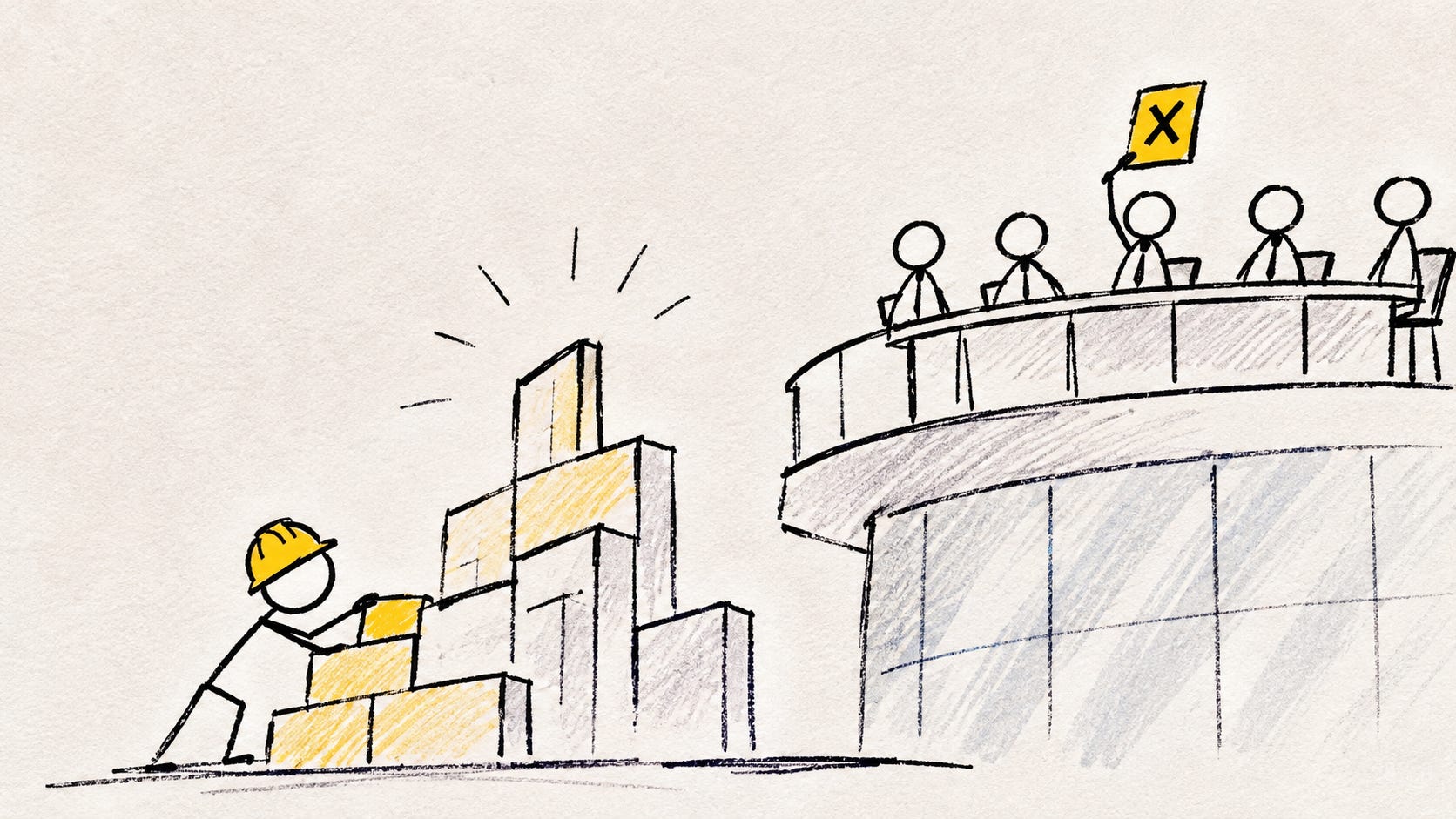
There is something rather strange about the modern corporation.
Someone spends decades building a business. They develop products people want, convince customers to pay for them, attract investment, employ thousands of people and create an enterprise worth billions.
Along the way, they bring in professional managers, lawyers, accountants, investors and directors to help the business grow. Then, one day, some of those people can decide that the founder should no longer run the company.
Sometimes, they’re absolutely right. But think about that arrangement for a moment. The people who were brought in to help manage and protect the business can eventually acquire the power to remove the person who built it. And they don’t necessarily need to possess anything approaching that person’s ability to create a successful business.
I’ve always found that an interesting distribution of power.

The recent controversy surrounding Jensen Huang and NVIDIA, one of the world’s most valuable companies by market capitalisation, brought the question back into focus for me. Huang co-founded NVIDIA in 1993 and spent more than three decades building it into one of the world’s most important technology companies. Its chips and computing systems have become central to the artificial intelligence industry.
On 12 November 2026, NVIDIA announced his resignation as CEO and director, following reports that he had been targeted by a foreign intelligence effort. The company had already announced an independent investigation, stating that it had no reason at that stage to believe national security or its secrets had been compromised.
These are serious matters. The circumstances surrounding Huang’s departure deserve proper examination, as does the question of what best serves the company’s long-term interests.
Whatever the eventual findings, Huang’s contribution to building NVIDIA is extraordinary. And his departure raises a question that extends far beyond one company or one individual.
How much should a company be prepared to lose when deciding whether to remove someone who has demonstrated an extraordinary ability to create value?
And, perhaps more importantly, how do we know the people making that decision properly understand what they’re putting at risk?
The rise of the managerial class
In 1941, a political thinker named James Burnham published a book called The Managerial Revolution. His argument was that power in modern economies was increasingly moving away from the people who owned businesses and towards the professional managers who controlled their operations.
Think about a small family business. The owner usually decides what to sell, who to employ, how to spend the money and what direction the business should take.
Now imagine that business grows into a large corporation. It brings in investors, hires executives, appoints a board of directors and creates departments for finance, legal affairs, compliance, operations and human resources. Before long, the person who started the business may no longer have the final say over how it is run.
Burnham was interested in this shift. So were Adolf Berle and Gardiner Means, who had examined the separation of ownership and control in their 1932 book, The Modern Corporation and Private Property.
Their ideas help explain something important about modern business: owning a company, running it and controlling the people who run it are three different things.
You might own 20% of a company but have little influence over its board. You might own only 10% but hold special voting rights that give you effective control. Or you might own no shares at all and still exercise considerable power because of your position within the organisation.
The history is more complicated than managers simply taking over everything. Investors have repeatedly tried to strengthen their control over professional executives, while some founders have negotiated special rights to protect themselves.
But the central issue remains. The people with the authority to make decisions about a business are not necessarily the people who created the value that makes the business worth controlling.
Other thinkers, including Gaetano Mosca and Robert Michels, explored similar questions about how power becomes concentrated within organisations. Their work is particularly interesting to me because it suggests that once people acquire positions of authority, preserving that authority can become an objective in itself.
This can happen in governments, political parties, universities, professional associations and businesses. It doesn’t mean everyone in management is power-hungry. It means we should pay attention to who holds power, what they gain from exercising it and who bears the consequences when they get things wrong.
Builders matter more than administrators
I have a fairly strong view on this.
Builders are more important to productive enterprise than administrators.
That doesn’t mean administrators are useless. Far from it. But there’s a basic economic relationship here that I think we sometimes lose sight of.
Before you can administer a successful business, someone has to build one.
Someone must identify a problem people care enough about to pay to solve, create a product or service, find customers and establish a business model that makes economic sense. Then they have to keep doing it, at a larger scale, against competitors, through changing markets, failed products, rising costs and periods when money is scarce.
It’s extraordinarily difficult, and many businesses never get there. A startup might have millions of users, attract substantial investment and generate enormous publicity without ever figuring out how to make more money from its customers than it costs to serve them.
That’s a problem no amount of impressive corporate administration can permanently solve.
Once a successful business exists, accountants can improve financial reporting, lawyers can negotiate contracts, executives can manage departments and directors can oversee strategy. These are valuable contributions. Some professional managers are exceptional builders themselves, creating new products, transforming businesses and opening markets that didn’t previously exist.
But the distinction between creating productive capacity and administering existing capacity remains important.
A company can improve its financial performance by cutting costs, selling assets, restructuring debt or buying back shares. Those decisions may be sensible and can create substantial value. Ultimately, however, a company cannot indefinitely create prosperity by rearranging its finances. Somebody has to produce something people actually want.
Without productive activity, there is ultimately nothing for the administrators to administer.
That’s why I believe people who have demonstrated an exceptional ability to build and sustain productive businesses deserve particular consideration when decisions are made about their continued leadership.
A founder isn’t always replaceable just because a CEO is
There is research supporting the idea that founder leadership can matter in ways that aren’t immediately obvious from a company’s financial statements.
A 2020 study published in Research Policy examined American public companies that experienced the sudden death of their chief executives between 1979 and 2002.
When founder-CEOs were replaced by professional CEOs, the researchers found a 43.8% decline in a measure of innovation based on patents and how frequently those patents were cited by later inventions. They also found that employee inventors were more likely to leave after those transitions.
Now, this doesn’t mean removing a founder automatically destroys 43.8% of a company’s value. The study measured innovation, not company valuation. It examined a particular group of businesses, and the sudden death of a founder is very different from a board deciding to remove one.
But it tells us something worth considering.
A founder may contribute far more than the work formally assigned to the CEO. They may be the person who understands the technology better than anyone else, who knows which products are worth developing, whose judgment attracts talented employees, or who understands the customer and the market in ways that are difficult to capture in a spreadsheet.
Remove that individual and the company may lose capabilities that aren’t immediately apparent.
A board might have five impressive candidates ready to take over as CEO. But being qualified to run a company doesn’t necessarily mean being able to reproduce what made that particular company successful.
Replacing the CEO can be straightforward. Replacing what makes the founder exceptional may be another matter entirely.
Remember Founder Mode?
In September 2024, Paul Graham published an essay called Founder Mode, inspired by Airbnb co-founder Brian Chesky’s experience of managing a growing company. It sparked a considerable debate.
As a business grows, founders are often advised to hire professional managers, delegate responsibility and stop involving themselves in the details. The thinking is that what worked when the company had 20 employees cannot work when it has 20,000.
There’s truth in that. A founder who insists on approving every small decision will eventually become a bottleneck.
But Graham raised another possibility. What if some of the things that make exceptional founders successful are precisely the things conventional management advice tells them to stop doing?
What if their direct involvement in product decisions, recruitment or customer experience is an important part of the company’s advantage? Should they withdraw simply because a management textbook says that’s how large companies are supposed to operate?
The right question is whether their involvement continues to make the business better. That should be determined by examining the results.
Founder Mode is useful because it challenges conventional assumptions about how businesses should be run. Founders still need to recognise when their own management practices become an obstacle to growth.
When the people who build the business lose control
Steve Jobs is probably the most famous example.
In 1985, Jobs lost his operational responsibilities at Apple following serious disagreements about how the company should be managed. Apple had genuine business problems at the time. Jobs could be difficult to work with, and there were legitimate concerns about his leadership.
So it’s too simplistic to say that a group of unimaginative executives removed a genius for no good reason.
But we know what happened later. Jobs returned in 1997 and led Apple’s transformation into one of the world’s most successful technology businesses.
We cannot know what would have happened if he had remained at Apple throughout. But the story illustrates the difficulty of judging what an exceptional founder brings to a company. The person might be difficult, make mistakes or have an unconventional approach to management, yet possess an ability to create value that is extraordinarily difficult to replace.
Of course, there are examples pointing in the other direction. Travis Kalanick at Uber and Adam Neumann at WeWork both helped build enormously valuable businesses, but their leadership also became associated with serious governance and commercial problems.
In some circumstances, removing a founder may be essential to protecting the company.
The lesson is that the decision to remove an exceptional builder should be taken with a proper understanding of what the company might lose, as well as what it stands to gain.
Why Zuckerberg made sure he couldn’t easily be removed
Some founders have recognised this problem and taken steps to protect themselves. Mark Zuckerberg is perhaps the clearest example.
Meta’s share structure gives Zuckerberg something far more valuable than his percentage ownership might suggest: control over shareholder decisions.
Its Class A shares carry one vote each, while its Class B shares carry ten votes each. In October 2026, Meta announced plans for a new class of non-voting shares, expected to take effect in January 2027. The arrangement is intended to give the company greater financing flexibility without diluting existing voting control.
In plain English, people can own shares representing similar financial interests but have very different voting power.
According to Meta’s October 2026 disclosures, Zuckerberg had approximately 13.4% of the company’s economic ownership but controlled around 60.6% of its voting power.
Think about what that means. He doesn’t need to own most of Meta to determine the outcome of shareholder votes on matters such as the election of directors. This gives him enormous influence over the board that would ordinarily supervise him as CEO, while still allowing other investors to provide substantial capital.
But there is a serious trade-off. The same arrangement that protects Zuckerberg from being displaced by investors who disagree with him also makes it harder for those investors to intervene if his judgment deteriorates, or if his decisions expose the company to serious legal, commercial or regulatory risks.
Founder protection can preserve extraordinary value. It can also preserve extraordinary mistakes.
That’s why the structure matters, and why the safeguards around it matter just as much.
Ford, Musk and the importance of keeping control
Henry Ford understood the importance of control long before modern technology founders began negotiating special voting shares.
Following disputes with minority shareholders, the Ford family consolidated ownership of Ford Motor Company in 1919. Ford had placed his son Edsel in the president’s position but continued to exercise substantial influence over the business.
The arrangement gave the family considerable freedom to determine the company’s direction. But Ford’s later years also illustrate the danger of excessive control. His resistance to changing market conditions and disagreements over management contributed to difficulties for the company.
Elon Musk offers another interesting example.
Musk lost his CEO position at X.com, the company that subsequently became PayPal, in 2000. At Tesla, he has maintained substantial ownership and influence, although he doesn’t have Zuckerberg’s majority voting control at Meta.
His experience illustrates why founders may be particularly concerned about who can appoint directors, who controls important shareholder votes and how much influence they retain after bringing in outside investors.
Compare that with Jensen Huang. NVIDIA’s March 2026 disclosures reported his beneficial ownership at approximately 3.58%.
That is a substantial financial stake in a very valuable company, but it is nowhere near the voting control Zuckerberg enjoys at Meta.
A founder’s contribution to creating a company and their legal power to control it can be completely different things.
And when those two things become separated, the founder may ultimately answer to people whose authority comes from the company’s governance arrangements rather than their own record of building the enterprise.
That is precisely the issue I’m concerned about.
Pavel Durov’s rather extreme solution
Telegram founder Pavel Durov offered his own perspective on the NVIDIA controversy, drawing on his experience of losing control of VKontakte, the social network he founded.
He argued that Huang’s mistake was having a board in the first place. Referring to his departure from VKontakte in 2014, which he attributes to refusing to cooperate with intelligence services, Durov suggested that boards can ultimately turn against their founders regardless of the circumstances.
His advice was provocative: “Don’t have a board. Be the board.”

Durov was making a serious point about founder power, although he delivered it with humour. His account of what happened at VKontakte is his own, and his assertion that NVIDIA’s board fired Huang goes further than NVIDIA’s public disclosures establish.
But his argument raises a question worth examining.
If you build something extraordinary, why voluntarily hand over the power to determine its future?
One answer is that you may need other people’s money.
When a company raises investment, investors usually want some protection. They may demand seats on the board, access to financial information or the right to approve certain major decisions. That is understandable. They are putting their capital at risk.
A founder running a profitable business with plenty of cash has more freedom to refuse unwanted conditions. A founder building something investors are desperate to back may also be able to insist on retaining control. Someone whose business desperately needs funding may have much less negotiating power.
So control isn’t simply a matter of what founders want. It’s also a question of how much bargaining power their business gives them.
Still, Durov’s proposed extreme isn’t a satisfactory general solution. A founder who answers to nobody can become a serious danger to the company, its investors, employees and customers.
The objective should be to protect the founder’s ability to create value while ensuring that serious wrongdoing or threats to the enterprise can be addressed.
The problem with the incentives of professional overseers
There’s another reason I worry about how these decisions are made.
Consider the position of a director serving on the board of a major company. A founder becomes involved in a controversy, and the director faces pressure from shareholders, lawyers, regulators, journalists and other stakeholders.
Keeping the founder may expose the board to criticism or legal risk. Removing the founder may appear to be the safer decision.
Now consider the possible economic consequences.
What if the founder was central to the company’s product development? What if key employees leave? What if the next generation of products never gets built? What if the business gradually loses the qualities that made it exceptional?
Those consequences might take years to become obvious. And when they do, it may be difficult to prove that the board’s decision caused them. The director who voted for removal may have left the board long before then.
That creates an uncomfortable possibility.
The risks of keeping a controversial founder can be immediate and visible. The costs of removing that founder can be delayed and much harder to measure.
This doesn’t mean boards routinely choose the wrong option. It means their incentives may encourage them to focus more heavily on the risks that are easiest to see and most dangerous to their own positions.
The opposite problem also exists. Directors may be too loyal to powerful founders and fail to intervene when they should.
We need governance systems capable of dealing with both.
Having the power to remove someone doesn’t mean removing them is wise
I am not arguing that founders should be untouchable.
A founder who commits fraud, abuses authority, seriously compromises the company’s interests or creates unacceptable national-security or regulatory risks may need to go. Their previous achievements cannot excuse everything.
Some misconduct is so serious that the company may have no responsible alternative to removing them. But where a board has a genuine choice, I think it should be required to think much more carefully about the consequences.
Before removing an exceptional founder, directors should be able to answer five questions.
1. What exactly has the founder done?
What happened, how serious is it, and what harm has it caused or could it reasonably cause?
2. Can the problem be addressed without removing them?
Could stronger supervision, changes to responsibilities or other measures adequately protect the company? Sometimes the answer will be no. But the question should be asked.
3. What does the company stand to lose?
Is the founder central to its products, technology, relationships, culture or ability to attract talented people?
4. Can someone else genuinely replace those capabilities?
Having another person ready to take the CEO position doesn’t necessarily mean that person can reproduce the founder’s contribution.
5. Why is removal expected to leave the company better off?
What are the likely consequences of keeping the founder, and how do they compare with the likely consequences of removing them?
These questions don’t give founders a legal right to keep their jobs. They don’t override the law or excuse misconduct. They simply require directors to consider the full consequences of their decision.
And I think the more exceptional the founder’s demonstrated contribution, the more seriously those consequences should be examined.
There is also a practical accountability measure worth introducing.
Where directors have discretion, they should document their reasoning before taking such a consequential decision. What risks did they identify? What alternatives did they consider? What capabilities might the company lose? Why did they believe their chosen course was better?
That record would allow the quality of their judgment to be examined later.
Directors shouldn’t be punished simply because a reasonable decision turns out badly. Business is uncertain, and nobody can predict every outcome. But they should be able to explain what they knew, what they considered and why they acted.
If you have the power to remove someone whose abilities helped create an extraordinary business, you should be able to demonstrate that you understood what you were putting at risk.
I’m part of the class I’m questioning
My interest in these questions is both professional and intellectual.
I’m a lawyer and adviser who works extensively with entrepreneurs, investors and businesses. I’m also a student of elite theory, the study of how relatively small groups acquire and exercise power within societies and institutions.
In fact, the advisory firm I’m building, Pareto Mosca Elite Advisory, takes its name from two of the thinkers whose work has influenced how I understand power.
I spend a considerable amount of time thinking about who holds power, how they acquire it, how they keep it and what happens when their interests diverge from those of the institutions they control.
But there’s an important irony. I’m part of the professional class whose authority I’m questioning.

My work involves helping people structure transactions, raise capital, establish governance arrangements and manage commercial risks. I understand why these services matter, and I know that good lawyers, financiers, managers and directors can make enormous contributions to a business.
But I also understand the difference between helping someone build an enterprise and possessing the unusual ability to create one. Those of us who work in the professional services surrounding businesses have a particular responsibility to remember that distinction.
Our work should help productive enterprises succeed. The structures we create should protect the business without unnecessarily undermining the people and capabilities responsible for its success.
And we should judge our work by more than whether the paperwork was correct and the procedures were followed.
The business itself must matter.
Who holds the people in charge accountable?
Modern corporations have made it possible to organise people, capital and technology on an extraordinary scale. Professional managers, directors and advisers have played an essential role in making that possible.
An exceptional founder can become a danger to the business they created. That is why credible oversight matters. Equally, the people appointed to supervise that founder can make decisions that damage or destroy the very value they’re supposed to protect.
That is why accountability must run in both directions.
And this issue extends beyond trillion-dollar technology companies. It appears whenever the people who control an organisation become separated from those whose abilities, judgment or work make it successful. In family businesses, partnerships, professional firms, growing startups and even public institutions.
Who gets to decide? What qualifies them to decide? And who bears the cost when they’re wrong?
For me, the starting point is simple.
Builders are more fundamental to productive enterprise than administrators.
That doesn’t place them above the rules. It means the rules should recognise the value of what they build, and the consequences of taking that capability away.
We’ve developed sophisticated systems for supervising the people who create value.
Perhaps it’s time we paid equally serious attention to the people doing the supervising, and what happens when they get it wrong.