

Two months before Authentic Brands Group acquired the intellectual property behind October’s Very Own, OVO was fighting a lender over an alleged $4.6 million debt.
A.R.I. OVO Growth Capital had financed the Drake co-founded lifestyle business through convertible notes issued in 2025. By June 2026, the relationship had deteriorated into litigation in two Canadian courts. A.R.I. claimed at least $4,609,455.72 remained outstanding following defaults, a forbearance agreement and partial repayment. OVO disputed whether a substantial component of that claim — a contractual make-whole fee — had actually become payable.
On 24 August, OVO completed a very different kind of capital transaction.
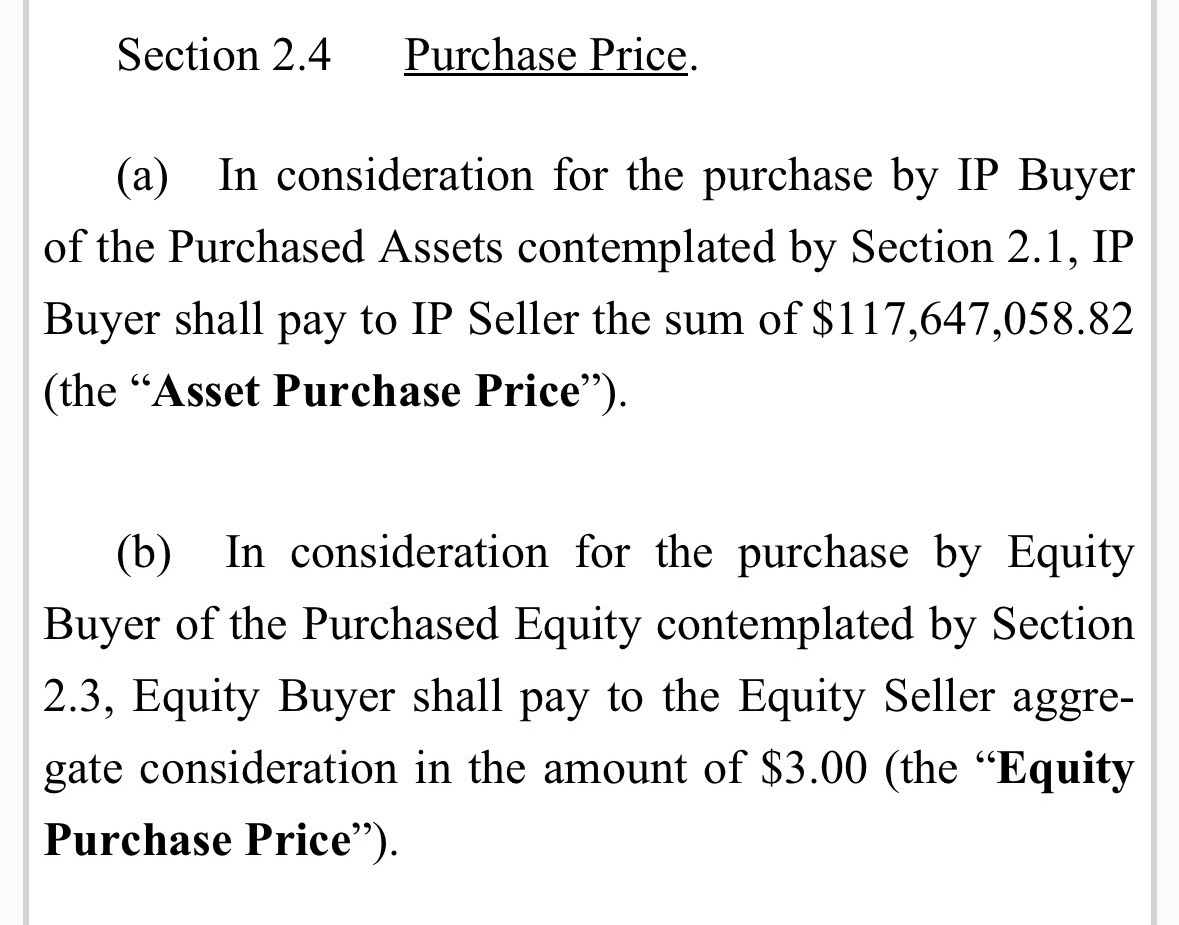
Its intellectual property was transferred to ABG-OVO, a newly formed vehicle controlled by Authentic Brands Group, under an Asset and Equity Purchase Agreement that placed a contractual purchase price of $117,647,058.82 on the acquired IP. Drake emerged with 44% of ABG-OVO, Authentic with 51%, and Vince Holding Corp. separately acquired the remaining 5%.
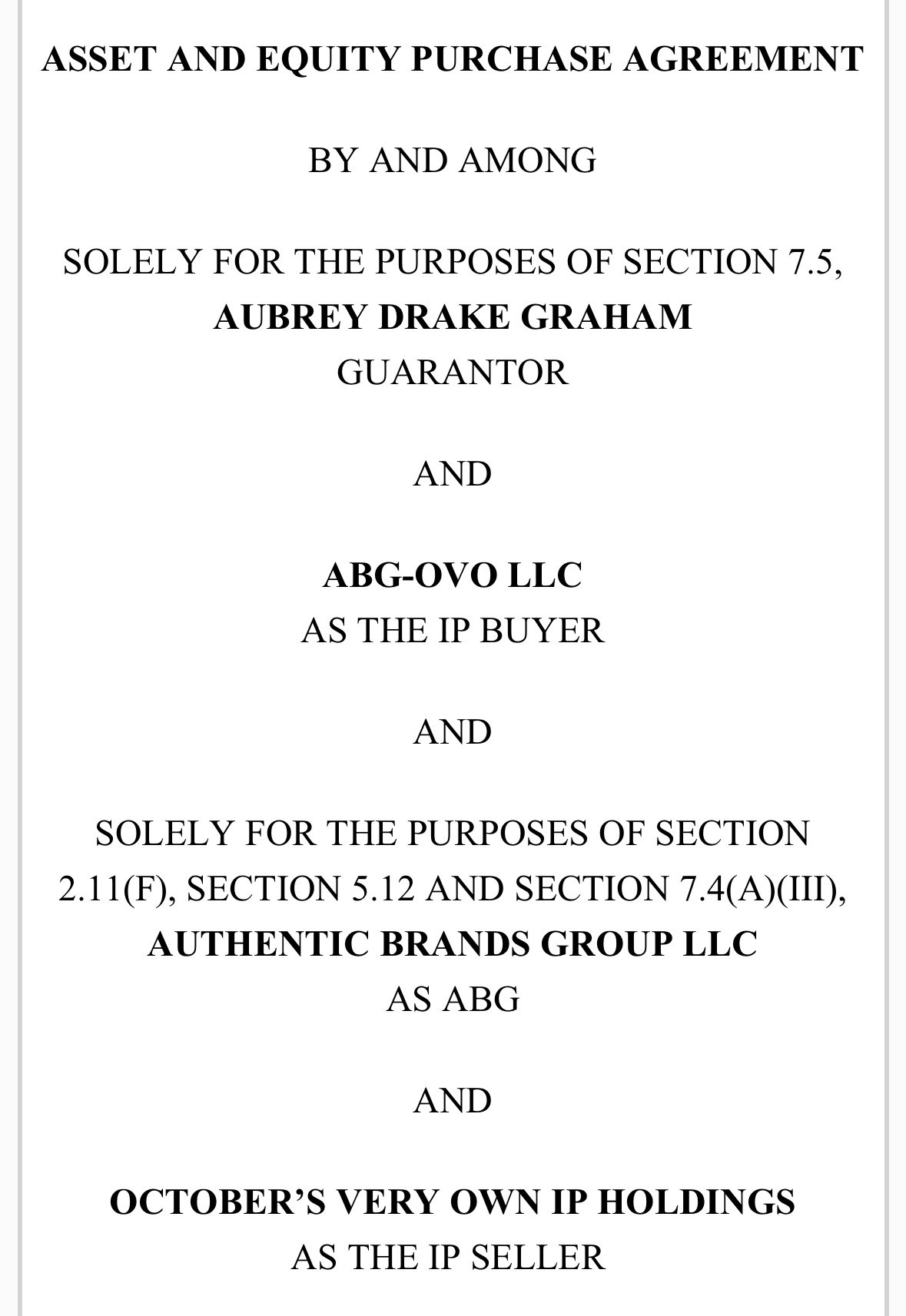
OVO’s Canadian, US and UK operating companies ended up somewhere else entirely. Vince acquired 100% of them after a pre-closing recapitalisation and repayment of defined OVO debt.
The stated consideration for those companies was $3. Yes, your read that correctly; three dollars.
The juxtaposition is useful because it exposes a distinction that tends to disappear when we talk about intellectual property as an asset class. OVO could possess culturally and commercially valuable IP while its operating company faced liquidity pressure and disputed creditor claims. Extracting financial value from the former required considerably more than establishing what the brand might be worth.
The transaction had to convert OVO’s cultural value into something that different forms of institutional capital could own, govern and exploit.
That conversion is the interesting part.
What the transaction actually did
OVO already had some separation between intellectual property and operations before the transaction. October’s Very Own IP Holdings, an Ontario general partnership, sat on the IP side, while October’s Very Own ULC owned the Canadian, US and UK merchandising companies.
The separation was incomplete. Relevant intellectual property remained distributed across parts of the OVO ecosystem, including operating companies and individual founders. The purchase agreement therefore required pre-closing assignments that consolidated specified rights into the IP seller before Authentic’s vehicle acquired them.
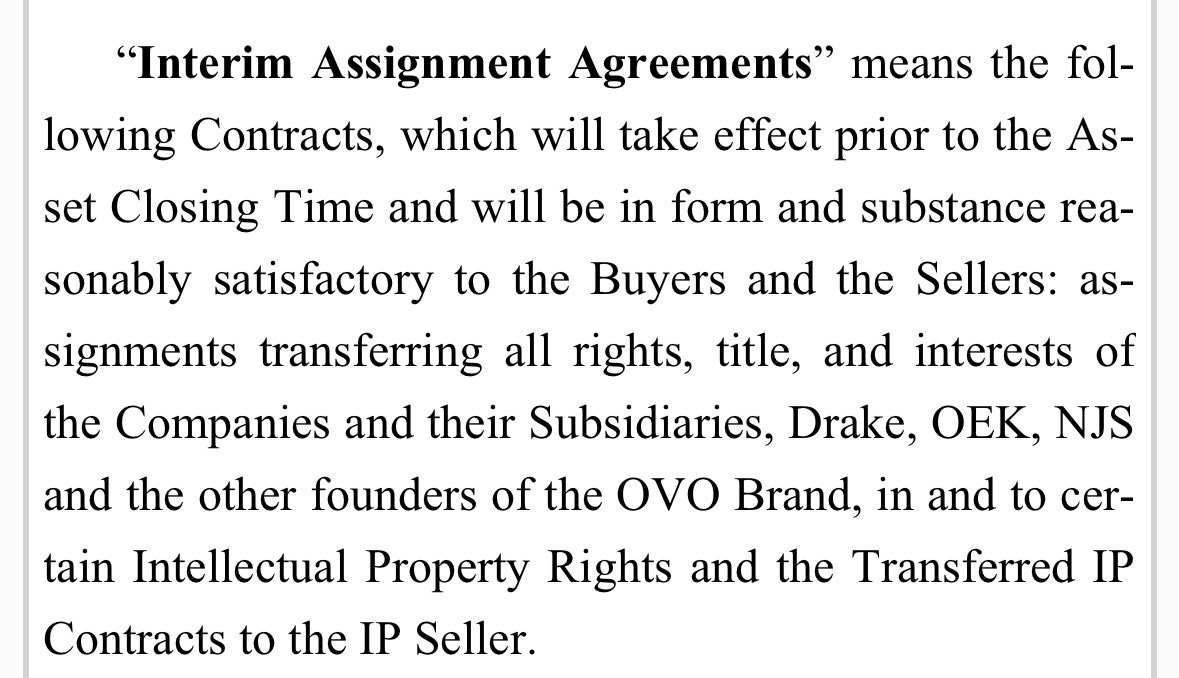
That is easy to treat as transactional housekeeping. For an institutional buyer, it goes directly to the asset being purchased. Cultural recognition does not establish title. An investor needs to know which trademarks, copyrights, contracts and associated rights fall inside the acquisition perimeter, who owns them, whether they can be transferred, and whether anyone else has claims against them.
OVO had recent experience of the importance of competing claims against an asset. It paid approximately $3.7 million of principal toward the A.R.I. claim in May 2026; A.R.I. maintained that a further contractual make-whole fee of roughly $3.8 million remained payable, which OVO disputed.
The August transaction does not publicly establish that this disputed A.R.I. claim was settled through the closing, and it would be unsafe to infer that it was. What the transaction documents do establish is the required sequencing. The sellers had to cause the defined “OVO Debt” to be repaid and satisfied, with related liens released, before Vince acquired the operating companies. The IP purchase, equity subscription and debt repayment all occurred ahead of Vince’s equity purchase, and Vince expressly did not fund the subscription or repayment.
The consideration mechanics explain how that could happen.
ABG-OVO’s contractual purchase price for the IP was $117.65 million, but that figure should not be read as cash proceeds received by Drake. The purchase consideration incorporated several components and destinations, including equity consideration, creditor and convertible-note payments, transaction expenses, funding into the operating business and cash payable to the seller.
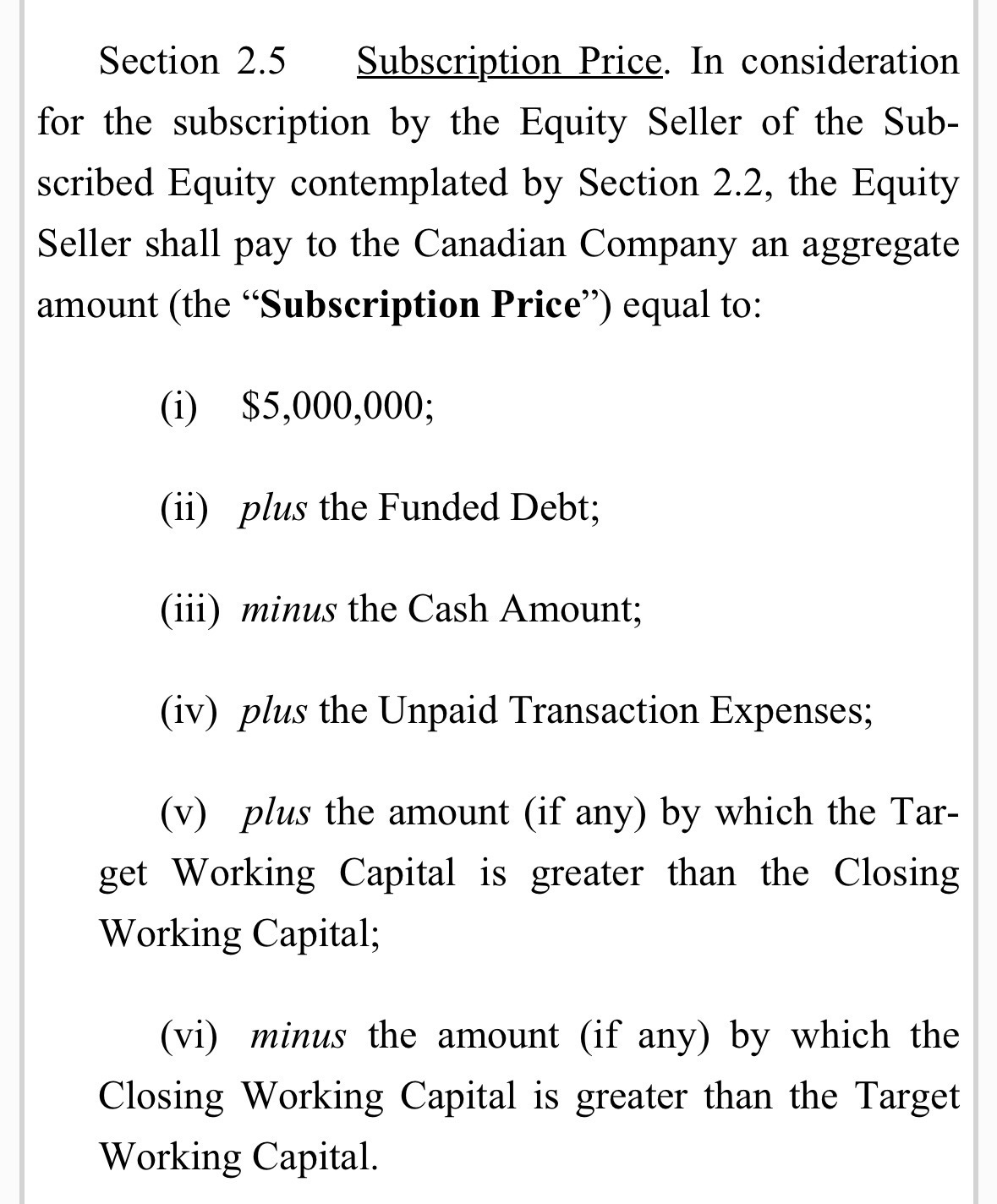
Immediately before Vince acquired the operating companies, October’s Very Own ULC also subscribed for additional shares in the Canadian OVO company. The subscription price started with $5 million and was then adjusted for funded debt, cash, unpaid transaction expenses and working capital. Part of the economic value released through the IP transaction was therefore directed into cleaning and recapitalizing the business that would continue exploiting the brand.
Vince then acquired the three operating companies for the stated $3 consideration.
The figure makes more sense when viewed at the end of that sequence. The principal OVO intellectual property had already moved into ABG-OVO. Defined debt had been required to be discharged. The operating business had received additional capital. Vince was acquiring the operating platform, assets and liabilities that remained and assuming responsibility for commercial execution under licence from the new IP owner.
Vince also paid $6 million for a 5% interest in ABG-OVO, purchasing those units from the OVO seller side rather than receiving them from Authentic. On that transaction alone, the arithmetic implies a $120 million equity value for ABG-OVO. That sits close to the $117.65 million contractual IP purchase price, although the two figures describe different things and should not be treated as interchangeable valuation measures.
After closing, the allocation is unusually clear. Authentic controls 51% of the vehicle owning the IP. Drake retains 44%. Vince owns 5% of the IP vehicle and 100% of the operating companies.
The licence connecting those layers deserves as much attention as the ownership percentages.
Vince receives long-duration rights to design, manufacture, market and sell specified OVO products, with an initial term extending through its 2036 fiscal year and three potential seven-year renewals. It pays royalties on net sales and commits to guaranteed minimum royalties, minimum net sales and minimum retail-store requirements. ABG-OVO retains approval and other brand-control rights.
Those operating rights are narrower than “global OVO licence” might suggest. The United States and Canada form the Core Territory. Much of the rest of the world begins as an Option Territory that ABG-OVO can change unilaterally, subject to a right of first offer for Vince over specified European markets. Certain product categories receive similar treatment: ABG-OVO can alter the Option Products after closing.
The termination allocation is similarly uneven. Vince has termination protections for specified failures on the licensor and principal side, while ABG-OVO has a broader set of termination triggers tied to Vince’s performance and conduct, including payment failures, minimum-store and minimum-sales failures, insurance deficiencies, cessation of operations and insolvency events.
The consequences can extend beyond the licence itself. If ABG-OVO terminates the agreement in accordance with its terms, Vince’s units in the IP vehicle may, at ABG-OVO’s option, be redeemed and cancelled for no consideration or transferred for no consideration to the remaining members. Vince can therefore lose the 5% IP interest for which it separately paid $6 million if the operating relationship fails in circumstances giving ABG-OVO a termination right.
That makes the 5% stake particularly interesting as an alignment mechanism. Vince receives its primary economic upside through ownership of the operating business, with additional participation in the IP value it is responsible for developing commercially. Yet that participation is tied to continued performance of the operating relationship. Authentic retains control of the asset and substantial protection against operator failure, while Drake preserves a large economic interest in the IP.
The agreements also address Drake’s continuing contribution through specified “Drake Services”, bringing part of the brand’s dependence on its principal cultural figure within the contractual framework. The licence separately addresses circumstances in which Drake can no longer provide those services or other specified principal-related events occur.
These are deliberate and uneven allocations of risk and return. The creator, controlling IP owner and operator are each contributing something different, so their rights do not need to mirror one another.
Authentic and Vince had already used a related structure in 2023. Vince transferred its own brand IP into ABG Vince, in which Authentic owns 75% and Vince retained 25%, while Vince continued operating the business under licence. The OVO economics differ in an important respect: Vince’s 25% interest in its own brand vehicle formed part of the transaction through which it monetised its IP, whereas its 5% OVO interest was a separate $6 million purchase from the OVO seller side.
OVO therefore demonstrates a more distributed version of the model. Cultural participation can remain substantially with a creator, control of the intangible asset can sit with an institutional IP owner, and operating responsibility can sit with a specialist commercial platform. The economics and protections connecting those parties can then be calibrated to the particular asset.
Vince itself describes OVO as the first expansion of its multi-brand platform strategy beyond the Vince brand. Whether that develops into a repeatable operating role across Authentic’s wider portfolio remains to be seen.
What OVO tells us about institutionalizing cultural IP
The transaction provides a useful way to separate three jobs that often get compressed into a single conversation about “IP valuation”.
The first is legal institutionalization.
A culturally important body of rights has to become a legally intelligible asset. That means establishing ownership and chain of title, aggregating rights where necessary, defining the acquisition perimeter, identifying encumbrances and contractual restrictions, and determining which rights can actually be transferred or licensed.
OVO’s pre-closing assignments are a straightforward example. The institutional buyer required a rights estate capable of being acquired. Existing debt and liens also mattered because ownership of an asset is economically different when another party possesses security or enforcement rights over it.
For African music, the equivalent work may involve establishing master and publishing ownership separately, reconciling split sheets, assignments and producer interests, confirming distribution and publishing-administration agreements, identifying recoupment positions and determining who actually possesses collection rights in each relevant territory.
The second job is financial institutionalization.
Once the legal asset can be identified, its economics need a form that capital can underwrite. OVO placed the IP into a dedicated vehicle with separately identifiable equity interests. Commercial exploitation then generates contractual royalty obligations, supported by guaranteed minimum royalties and minimum-performance requirements.
This creates several distinct economic exposures. Authentic and Drake participate primarily through the IP vehicle. Vince captures the economics of operating the consumer business while also holding a small interest in the IP. The operating companies and the intangible asset can be capitalised differently because they no longer have to live on the same balance sheet.
The appropriate financial machinery for a music catalogue could look very different. A catalogue generating mature royalty streams might use an IP SPV, controlled collection accounts, servicing arrangements and a distribution waterfall capable of supporting debt or other structured capital. An earlier-stage catalogue with volatile cashflows may require equity or revenue-participating capital before it can support senior financing. The institutionalisation problem remains even where the instrument changes: capital needs a sufficiently defined claim on sufficiently observable cashflows.
The third job is operational institutionalization.
This matters particularly for cultural assets because their value often remains dependent on people and businesses that the IP owner does not control day to day.
OVO still depends on Drake’s cultural relevance and creative involvement. Its apparel economics depend on Vince actually designing, manufacturing, marketing and distributing products successfully. The transaction responds by allocating those dependencies through contracts: creator services, product and territory rights, approval processes, minimum sales, guaranteed royalties, store requirements, termination rights and consequences for failure.
Different cultural assets require different versions of this layer.
A mature music catalogue may have limited continuing dependency on the original artist but substantial dependency on distributors, publishers, collection societies and administrators. Operational institutionalisation may therefore focus on servicing standards, collection mandates, audit rights and replacement-servicer mechanisms.
A creator-led consumer brand presents a different problem because the human being may remain integral to the asset’s future value. OVO’s treatment of Drake becomes more relevant there.
Film and television libraries introduce another configuration: chain of title, territorial rights, residual obligations, distribution windows, platform licences and continuing exploitation rights may dominate the analysis.
This is why importing one transaction structure wholesale into African cultural markets would miss the larger lesson. The institutionalisation function is repeatable; the legal, financial and operational machinery has to follow the asset.
That distinction also changes how we should think about Africa’s persistent IP financing gap.
There is already substantial evidence of commercial value in African music, film, sport, fashion and creator-led businesses. There is also growing interest from local and international pools of capital. Between those two things sits a conversion problem.
An investment committee needs more than evidence that audiences value an artist, catalogue or brand. It needs an identifiable investment perimeter, defensible rights, reliable information, a claim on cashflows, workable governance, defined counterparties and credible remedies when performance or collection fails. Where several rights owners, distributors, publishers, collection societies or jurisdictions sit between the asset and its revenues, someone has to organise those relationships into a form capable of being underwritten.
OVO is useful because it shows that work happening inside a real transaction.
Legal institutionalisation established and separated the rights capable of institutional ownership. Financially, those rights were placed in a separately capitalised vehicle and connected to contractual cashflows. The operational layer then allocated responsibility among the creator, controlling IP owner and commercial operator, including meaningful consequences for underperformance.
Those choices were deliberately uneven because the parties were contributing different things and carrying different risks.
African cultural assets will require their own allocations. Some will need rights aggregation before they need valuation. Some will need collection reform before they can support financing. Some will need creator arrangements that preserve the human source of cultural value while allowing institutional capital to participate economically. Others will require operating companies and IP to be separated so that the asset can survive problems elsewhere in the business.
The opportunity therefore extends beyond finding investors willing to recognise the value of African culture. There is substantial work to be done converting that value into assets those investors are structurally capable of holding.
Valuation can tell capital what an asset may be worth.
Making it investable requires legal, financial and operational institutionalization — in forms appropriate to the asset.