

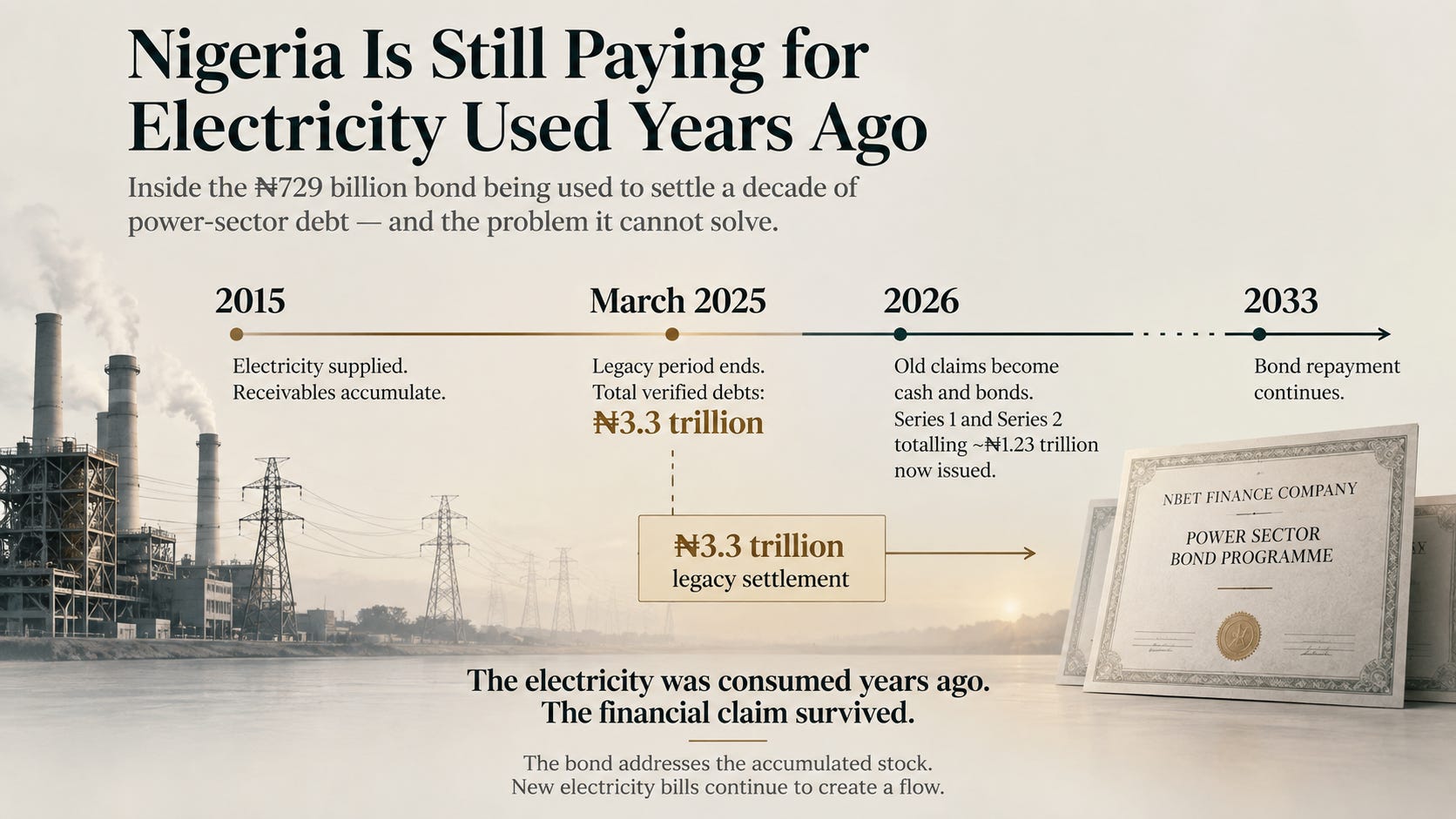
The electricity was used years ago.
Homes were lit. Factories ran. The power itself disappeared the instant it was consumed.
But part of the bill survived.
This month, Nigeria completed a ₦729 billion bond transaction to help settle old debts owed to the companies that generated that electricity.
It is a strange journey for an electricity bill. Power supplied years ago became an unpaid invoice. That invoice sat on a company’s balance sheet. Now some of those claims are becoming financial assets that investors and power companies can own.
What interests me about the transaction is what it reveals about subsidies more generally.
Every subsidy has to sit on someone’s balance sheet.
If government promises to pay part of a bill but does not provide the money when payment falls due, the cost does not disappear. Someone else carries it until government does.
Nigeria’s power sector shows what can happen when that continues for years.
Every subsidy has to sit somewhere
The basic electricity business is simple even when the Nigerian market around it is not.
Generation companies, or GenCos, produce power. Distribution companies, or DisCos, sell it to customers. The Nigerian Bulk Electricity Trading company, NBET, sits between them as the bulk buyer. Money is supposed to travel back through that chain until the generator gets paid.
There is another payer in the chain: the Federal Government.
Many electricity tariffs in Nigeria have historically been set below the cost recognised by the regulatory system for supplying the power. Where the permitted tariff does not cover the full relevant cost, government assumes the subsidy portion.
The numbers give a better sense of what this means.
In the fourth quarter of 2025, GenCos invoiced ₦804.93 billion for electricity supplied. After adjusting for the tariff subsidy, NBET billed DisCos ₦386.13 billion. The Federal Government’s subsidy obligation was ₦418.79 billion.
For every ₦100 the GenCos invoiced that quarter, roughly ₦52 was government’s bill.
The DisCos remitted ₦359.27 billion of the ₦386.13 billion they were required to pay, equivalent to 93.04%.
That complicates the familiar explanation that Nigeria’s electricity payment problem comes down to customers not paying enough or DisCos failing to remit enough. Both remain real problems. In that particular quarter, however, more than half of the generation bill had been allocated to government because permitted tariffs did not recover the full cost.
Government had effectively said: consumers will pay this part; we will pay the rest.
Once government makes that promise, the subsidy is a financial obligation.
Some power companies became involuntary lenders
The debts now being settled predate the current payment system.
They accumulated between February 2015 and March 2025, across a decade in which the electricity market operated under different arrangements.
Following its review and verification process, the Federal Government agreed ₦3.3 trillion as the full-and-final settlement of the legacy debts. By April, 15 power plants had signed settlement agreements covering ₦2.3 trillion of that amount.
Strip away the institutional complexity and the underlying problem is fairly ordinary.
Electricity had already been supplied.
If a generator supplies ₦100 of electricity and receives only ₦60, it carries the missing ₦40 as a receivable until somebody pays it or the claim is otherwise resolved.
Meanwhile, its own bills keep arriving. It may owe its gas supplier. It may have bank debt to service. Turbines require maintenance. New generating capacity requires investment.
So an unpaid electricity invoice can travel backwards through the power sector long after the electricity itself has travelled forwards to the consumer.
Where the missing payment represents an obligation another party had assumed, the GenCo effectively becomes an involuntary lender.
I think that is a useful way to understand what happened here. The power company did not set out to extend credit. It supplied electricity expecting payment under an agreed market structure. Until the money arrived, however, the unpaid amount remained on its balance sheet.
The Federal Government’s response is the Presidential Power Sector Financial Reforms Programme, a programme of up to ₦4 trillion intended to settle verified legacy obligations and restore liquidity to the sector.
A central part of that solution is the bond market.
An unpaid invoice becomes a security
The first issuance closed in January.
NBET Finance Company, a special-purpose company established for the programme, issued ₦501.02 billion of seven-year bonds. It did not raise all ₦501 billion in cash.
₦300 billion was raised from capital-market investors. Another ₦201.02 billion of bonds was allotted directly to participating power generation companies.
There are two different things happening here.
Some investors provide new money that can be used to pay creditors. Some creditors receive a bond in place of part of an old receivable.
For a GenCo in the second group, an old claim for money already due becomes a formal promise to pay under defined terms in the future, with interest and Federal Government credit support.
That is not the same thing as receiving cash today.
Seplat gives us a real example. Its half-year accounts record ₦3.87 billion face value of NBET Finance bonds received as part of the settlement of outstanding power receivables.
Before the exchange, the economic position was essentially that NBET owed it money for electricity already supplied. Afterwards, it held a security with defined payment terms and Federal Government credit support.
The latter can be a materially better asset. An uncertain historical receivable sitting on a power company’s balance sheet is different from a formal debt security with specified interest and maturity.
The Series 1 bonds carry a fixed annual coupon of 17.5% and mature in January 2033.
Series 2 takes the programme further. It totals ₦728.979 billion, comprising ₦402 billion of cash bonds raised from the capital market and ₦326.979 billion of non-cash bonds allotted to participating GenCos.
Together, Series 1 and Series 2 amount to approximately ₦1.23 trillion.
So the programme is doing more than paying old bills. It is changing the financial form of the claims.
A naira owed years ago is not worth the same as a naira paid today
There is another cost buried inside years of delayed payment: time.
Suppose a power company was owed ₦1 billion several years ago and receives the same nominal ₦1 billion today. The numbers may match. The economic value does not.
Inflation has reduced what each naira can buy. Naira depreciation matters too where equipment, replacement parts, financing or other costs have direct or indirect foreign-currency exposure.
Then there is the opportunity cost. Money trapped in an unpaid receivable cannot simultaneously be used to reduce debt, maintain equipment, expand capacity or fund another productive investment.
The creditor has also spent those years carrying uncertainty over when it will be paid, how much of its claim will ultimately be recognised and what form the settlement will take.
This is why “money owed to GenCos” does not quite capture the economic burden.
For affected companies, carrying these receivables can look a lot like extending credit without having first negotiated the interest rate, maturity date or other protections an ordinary lender would usually demand.
The bonds change that position.
Series 1’s 17.5% coupon puts an explicit price on the financing from this point forward. There is now a maturity date and defined payment terms.
What the bond cannot do is travel backwards in time. It does not automatically restore whatever economic value may have been lost during the years before the restructuring. That depends on how individual claims were calculated and settled.
The old claim is now clearer and, potentially, more valuable.
The intervening years are still gone.
You can refinance a stock. You have to fund a flow.
This, for me, is the most important distinction in the transaction.
The ₦3.3 trillion settlement deals with a stock of historical obligations accumulated over roughly a decade.
But the electricity market continues to create a flow of new payment obligations every month that electricity is generated and permitted tariffs do not recover the full relevant cost.
The legacy settlement stops at March 2025.
The electricity market did not.
Nine months later, in the fourth quarter of 2025, the Federal Government incurred another ₦418.79 billion of electricity subsidy obligations in just three months.
NERC itself identifies the problem with the current arrangement. Because the subsidy is open-ended, government’s eventual obligation depends on variables including how much electricity is generated and what that electricity costs.
You can take a stock of accumulated debt, verify it, negotiate it and refinance it.
A continuing flow has to be funded as it arises.
If it isn’t, today’s flow eventually becomes tomorrow’s stock.
That is why I would be careful about treating successful bond issuance as evidence that Nigeria has repaired the economics of its electricity market. What it tells us is narrower, though still important. Nigeria has found a mechanism for financing part of the legacy balance sheet.
The bond repairs the balance sheet, not the payment loop
None of this makes the bond a bad transaction.
Clearing verified arrears can put cash back into GenCos. Replacing uncertain historical receivables with defined securities can strengthen their balance sheets. Federal credit support can improve the quality of the claims creditors hold. Money reaching generators can also travel onwards to gas suppliers, lenders and contractors.
There is real financial repair happening here.
The harder task is preventing the market from recreating the balance sheet that now needs repairing.
The real test is whether Series 10 ever needs to exist
The Federal Government appears to recognise this.
The debt programme sits alongside reforms involving metering, tariffs, collections and better targeting of electricity subsidies. In practical terms, Nigeria needs to measure more of the electricity being consumed, collect more of what is billed, recover more of the cost from consumers able to pay, and make whatever government support remains more deliberate and predictable.
That does not necessarily require eliminating electricity subsidies.
Government may decide that some households should pay less than the full cost of their electricity. That is a policy choice. But it needs to know who it intends to subsidise, have a reasonable idea what that promise will cost, and fund the obligation when it falls due.
Otherwise, today’s flow becomes tomorrow’s stock.
And eventually somebody has to refinance it again.
Nigeria can settle every verified naira of yesterday’s electricity debt and still recreate the same problem if today’s electricity continues generating obligations that are not funded when due.
So I would judge the ₦729 billion bond twice.
First, does it settle the debts it was designed to settle and restore liquidity to the power sector?
The second test comes later. Once the historical balance sheet has been cleaned up, does electricity sold today increasingly get paid for today?
If it does, the programme will have helped repair more than the past.
If it does not, the number attached to the next clean-up will start accumulating again.
A bond can give yesterday’s electricity bill a new owner and a new payment date.
A functioning electricity market has to stop tomorrow’s bill from needing one.
The funny part of it is that Nigeria still cannot build the smallest power plant or transmission network entirely by herself.