

Drake’s deal with Universal Music Group, completed in 2021 and confirmed by UMG’s own chairman on a 2022 earnings call, was described as an “expansive, multi-faceted” arrangement covering recordings, publishing, merchandise, and visual media. Industry estimates put the figure north of $400 million. The exact number was never confirmed, and the industry didn’t wait for it. Nobody needed a number that size to be exact to treat it as proof of value, the biggest bag an artist can command, the scoreboard settled in the artist’s favor.
The size of a check doesn’t tell you who won the negotiation. It tells you how much was sold.
A $400 million deal does not necessarily create $400 million of new wealth. It may simply convert part of an artist’s future wealth into cash today. If the rights exchanged are worth more than the check, the headline number can rise while the artist’s economic position gets worse. The relevant metric is therefore not deal value. It is value retained.
Drake is not merely a compelling case study. He is a credible contender for the most commercially dominant recording artist of the streaming era, the first artist to hold the top three positions on the Billboard 200 simultaneously in the chart’s seventy-year history, and his counterparty is UMG, the largest music company in the world. That combination, extreme demonstrated demand meeting the largest label balance sheet there is, makes his situation an unusually clean live test of how much bargaining power an artist at the outer edge of scale can actually convert into ownership and better financing terms.
The Bundle, Split in Two
The prior piece in this series established that a major-label deal has never priced one thing. It bundles capital, distribution, marketing, and a claim on long-duration rights, and two of those four components, distribution and marketing, have been commoditizing for a decade. Any artist can reach every streaming platform for an annual fee. Audience-owned channels now move attention that a label’s promotional budget can’t easily match, and even the labels concede the point. A music-technology executive told The Hollywood Reporter in 2025 that the majors are evolving “more toward services companies.”
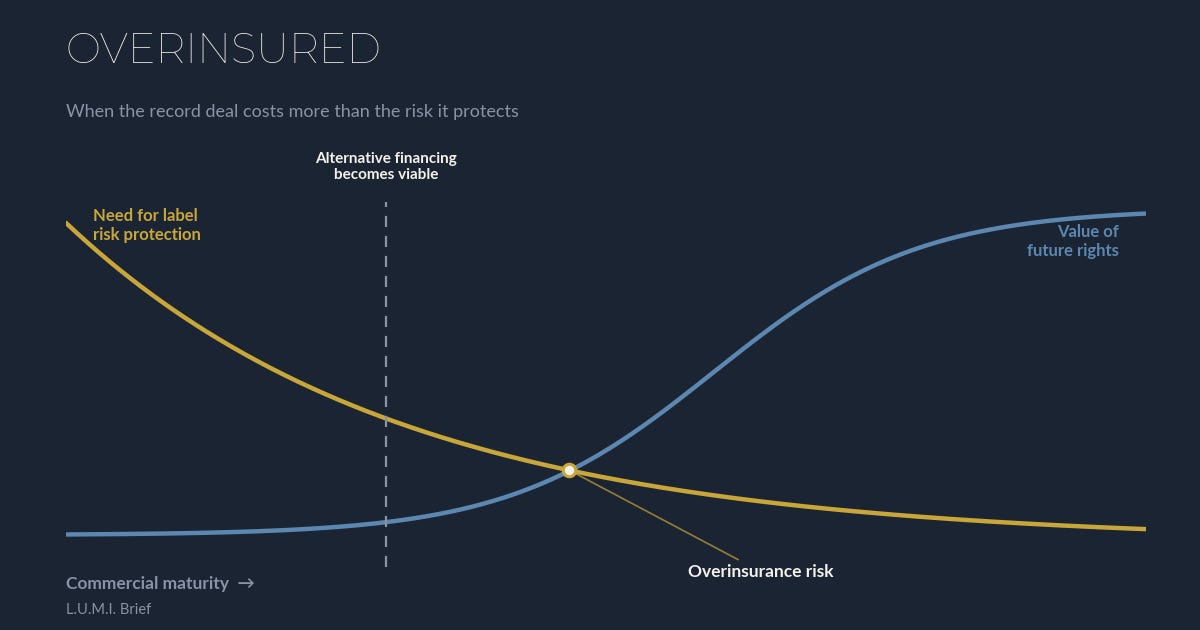
What’s left unbundled, and unexamined, are the other two pieces, capital and the label’s willingness to absorb the risk that the music simply doesn’t work. That second piece is worth assessing, because it isn’t really about marketing or distribution. It’s insurance.
A label advance guarantees an artist money regardless of what happens next. If the album flops, the artist keeps the cheque and the label eats the loss. In exchange, the label receives a claim on the artist’s rights that runs for years, sometimes decades, and that claim doesn’t shrink if the ‘flop-risk’ it was intended to cover never materializes. For a young artist with no other income, no catalog, and a real chance the whole thing goes nowhere, that trade can be rational. It’s the same logic behind why anyone buys insurance priced above its statistically fair value: when you can’t absorb the loss yourself, certainty is worth paying for even at an unfavorable price.
The open question is what happens to that trade once the risk it was pricing has fallen materially, while the price hasn’t moved with it.
What Taylor and Chord Together Prove
Two developments outside Drake’s own situation now let that question be asked with more precision than it could have been asked five years ago.
The first is Taylor Swift’s move to Republic in 2018. Her early deal with Big Machine, signed at fifteen, surrendered the masters to her first six albums in exchange for the standard early-career bundle, money, promotion, infrastructure she had no way to build herself. By the time she renegotiated as a global superstar with a demonstrated, repeatable audience, she stayed inside the major-label system on different terms: she would own every master she recorded going forward. This doesn’t prove that superstar leverage alone caused the shift. Universal’s desire to sign her, the broader evolution of artist bargaining power, and her own experience with Big Machine all played a part too. What it proves is more precise and useful. Needing a major label no longer has to mean giving it your masters.
The second development is what’s happened to the market for seasoned royalty income itself. In April 2026, Chord Music Partners, a platform tied to Universal through Dundee Partners, borrowed $500 million against royalty income from a large, diversified portfolio of songs, paying investors an interest rate of 5.56%, the tightest pricing on record for this kind of deal. A ratings agency, KBRA, has now rated close to $13 billion of these royalty-backed loans since 2020, and the number of companies doing this kind of deal has doubled since 2023. None of that tells you what it would cost to borrow against one artist’s future output alone. Lending against a single artist is a narrower, riskier bet than lending against thousands of songs from many artists, and it should cost more. But it does tell you that a seasoned, proven income stream now has a real, quoted price attached to it when used as collateral. Owning the rights and borrowing against them are no longer the same decision.
Put together, those two facts describe an artist enterprise where more of the bundle can now be separately priced than at any previous point in the modern music business. Whether it makes sense to keep buying all of it together is now more of a math problem than a loyalty question.
The Point Where the Insurance Stops Making Sense
Here’s the shape of that math problem, stripped down to numbers simple enough to hold in your head, and stated up front as a thought experiment rather than an attempt to reconstruct anyone’s actual contract terms.
An artist needs $100 million today. There are two ways to get it.
Under Structure A, the bundled path, a label pays the $100 million now, guaranteed, and takes half of whatever the artist’s future rights turn out to be worth. If the music flops, the label absorbs the loss and the artist keeps the cash. If the music succeeds, the label’s share rises right along with it. There is no ceiling on what half of a runaway outcome is worth.
Under Structure B, the unbundled path, the artist borrows the $100 million against seasoned catalog income already coming in, at an interest rate that has to sit meaningfully above the 5.56% a diversified catalog can borrow at, because lending against one artist alone is a narrower, riskier bet than lending against a large, diversified portfolio of songs. Call it something in the high single digits. The artist also pays separately for the distribution and marketing a label would otherwise have supplied, whether as a flat fee or a negotiated revenue share. The important difference is that these costs can be contractually bounded. Debt carries a defined repayment obligation. Services can be purchased for fees or a capped participation that doesn’t hand the provider a permanent claim on the underlying rights. Their economics don’t have to compound indefinitely alongside the value of the artist’s rights the way an equity-style claim does.
The two structures cross at a specific point. If the expected value of the artist’s future rights is modest, half of it is a small number, smaller than years of debt service plus service fees. The bundle wins there, and buying the insurance is the right call. But as the expected value of those future rights grows, half of it grows right alongside it, while the debt and the service costs stay within the bounds set at the start. There is a level of demonstrated, repeatable commercial output past which giving up half of an increasingly large number costs more than paying a bounded price for the pieces you actually still need.
This is the entire point, and it doesn’t require knowing what Drake’s contract says. A label sells a bounded amount of capital in exchange for a claim on an unbounded outcome. That trade is easiest to justify when the outcome is genuinely uncertain. It becomes progressively harder to justify as the expected value of the rights being surrendered rises and alternative financing becomes available.
The Honest Counterargument
UMG has priced Drake before. Its executives are not naive about audience data, streaming payouts, or what an artist with his track record is capable of producing. The size of a reported $400 million figure could just as easily be read as evidence the market already repriced his risk efficiently, rather than evidence of anything left on the table. It’s possible there is no mispricing here at all, and that a bundled deal at superstar scale already reflects everything this essay has just laid out.
There’s no way to settle that from outside the contract, and pretending otherwise would be the kind of overclaim this essay is trying to avoid. What can be said with more confidence is narrower and still matters. Five years ago, that external benchmark was far thinner. Now seasoned royalty income has an increasingly observable institutional price. Services have an observable, separately purchasable cost. The bundle isn’t automatically wrong at any given size. It’s testable in a way it wasn’t before, and that changes the information available in the negotiation, whether or not it changes the final number.
Drake’s own contract status remains publicly unclear as of this writing. That uncertainty is beside the point here on purpose. The argument doesn’t depend on how his situation resolves. It would hold whether he renews with UMG next month or walks away entirely, because the question was never really about Drake’s next cheque. It’s about whether the market now carries enough information to ask, of any artist at his scale, whether the policy still fits the risk.
The logic isn’t unique to music. Startups sell equity when revenue is uncertain and they have no collateral to borrow against, and that’s rational early and expensive later, which is why mature companies lean on retained cash flow and debt instead of repeatedly selling ownership once they’re able to. An emerging artist surrenders long-duration rights for the same reason a young company sells equity: uncertain output, no financing alternative. The real milestone isn’t independence. It’s creditworthiness, the point at which an asset that once needed someone else’s balance sheet develops one of its own.
The most sophisticated version of Drake’s next move might not be independence at all. It might be re-signing with UMG, on terms that price distribution, marketing, capital, and risk separately rather than as one bundled premium, because the label, priced correctly, may still be the cheapest and most capable counterparty for at least some of what he needs. That outcome and the exit outcome are not opposites. They’re both downstream of the same question: not how big is the cheque, but what did it cost to get it.
The artist became the platform. Whether the platform still needs the insurance it’s paying for is a number someone should now be able to check.
This follows an earlier piece, The Artist Has Become the Platform, on why the asset needed pricing in the first place.