


The Fundraising Gap No One Talks About
Most emerging GPs don’t fail because they’re bad investors.
They fail because the fund model assumes resources they don’t have.
Raising a fund in Africa or any frontier market means surviving 18–24 months between formation and first close — often with no management fees, $250–400k in setup costs, and LP cycles that stretch beyond two years.
Call it the Valley to First Close — a structural flaw that eliminates promising managers before they can prove their thesis.
The model wasn’t built for operators.
It was built for people who already had money.
Why the Model Breaks
The traditional VC/PE structure assumes the GP can self-fund until first close. That logic works in markets where managers come from investment banks, consulting firms, or family offices.
It collapses in markets where:
GPs are operators, not ex-bankers. They bring sector knowledge, not capital reserves.
Legal costs are disproportionate. Multi-jurisdictional setups, AML reviews, and cross-border counsel inflate fixed costs.
LP diligence is slow. DFIs and foundations can take 12–18 months from first call to wire.
The result: GPs drain savings to stay alive while waiting for commitments that may never land.
They’re running startups with no revenue and a single binary outcome — close or die.

The Economics of Survival
A $30–50M fund at 2% management fees should generate $600k–$1M a year — after first close.
But first close usually lands at only 30–50% of target. That means initial fees are $200–400k while setup costs stay fixed.
Those costs often look like this:
$80–150k legal, registration, compliance
$40–80k fund admin and audit prep
$60–100k LP outreach and travel
$70–120k GP overhead and working capital
Total: roughly $250–450k before a single dollar of management fee arrives.
Few managers can self-fund that runway.
Fewer can attempt it twice.
Fundraising becomes a test of endurance, not skill.
The Emerging GP Playbook
A new generation of fund managers is engineering around the gap rather than accepting it.
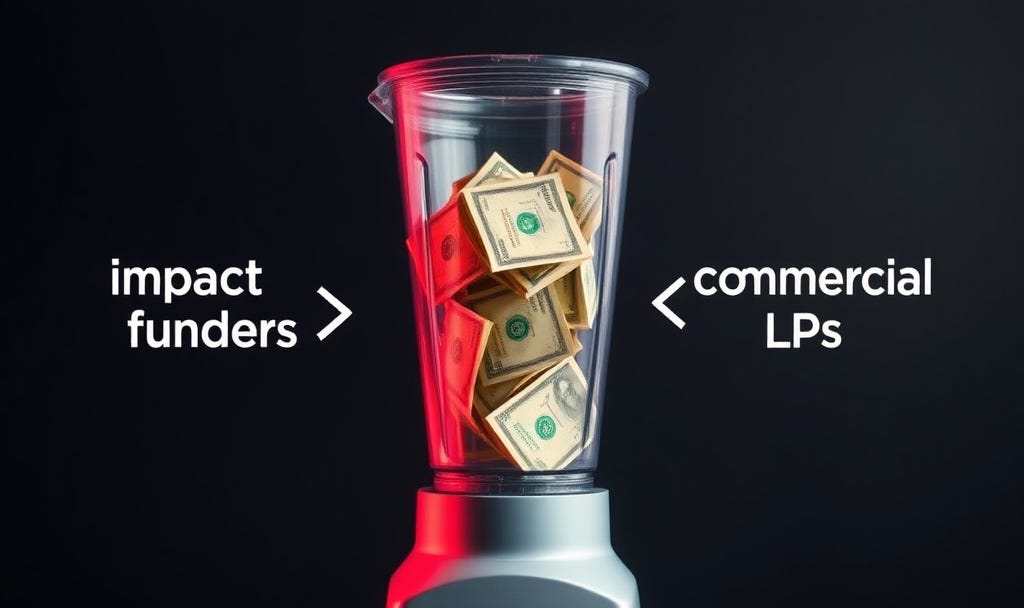
1. Build blended-capital scaffolds
Example: 54Co, Utopia Capital’s Africa fund II platform, paired a Delaware fund with a grant-funded non-profit operating entity.
The grant covered team, technical assistance, and capacity building — freeing the GP to focus on investing, not surviving.
Principle: Split the value chain. Use philanthropic or concessional capital for operations, and equity capital for deployment.
2. Negotiate pre-close cost recovery
Insert clauses in LPAs to reimburse pre-first-close costs once the fund reaches threshold.
LPs often cap this at 1–2% of first-close commitments, verified by a third party.
Not a blank check — but it removes existential cash pressure.
3. Use GP bridge facilities
A few DFIs and impact investors now provide short-term facilities for GP setup — advancing $100–250k against future management fees, repaid at 8–12% annually.
Structured as debt to the GP entity, not the fund, these bridges avoid dilution and governance friction.
Examples include Small Foundation’s GP Financing Facility and select DFI technical-assistance lines. Early but expanding.
4. Run “Phase 0” syndicates
Deploy early SPVs to prove execution before raising a fund.
A Nairobi climate fund raised a $500k SPV, co-invested in an off-grid solar venture with a European family office, exited at 2.1x in 18 months — and used that as proof to unlock a $12M first close from two DFIs.
Phase 0 syndicates build track record and test co-investment chemistry.
A working example beats a hundred pitch decks.
5. Operate the GP like a startup
Don’t wait for first close to act like a fund.
Treat the GP as a lean venture with milestones, budgets, and short cash cycles.
Some generate early revenue through:
Advisory or structuring mandates
Deal-sourcing fees for partners
Shared services for portfolio companies
These aren’t distractions — they’re signals.
Execution under constraint is what LPs are really underwriting.

The Reframe
For fund ecosystems in Africa, Southeast Asia, or the Middle East to mature, both sides must adapt.
GPs must stop treating first close as validation. It’s a liquidity event — the conversion of risk into survival. Design for that from day one.
Capital providers must recognise that capacity building and fund operations are one infrastructure. Funding only investments — not managers — selects for privilege, not performance.
Otherwise, capital will keep recycling through legacy managers who never had to survive the valley.
Final Thought
The next generation of fund managers won’t emerge from institutions.
They’ll emerge from operators who survived the gap — and built new models from it.
Endurance is the real GP alpha.

📬 Subscribe & Share
If this brief helped you see the GP journey differently —
➡️ Subscribe to The Lumi Brief for more analyses on venture, governance, and capital structuring across emerging markets.
➡️ Share this post with a GP or LP who’s living the valley.