

My grandmother was one of four wives in a Yoruba household. She started by hawking before she eventually secured a stall of her own. From the proceeds of that stall, she raised her children, including my father, the eldest across all four wives.
My father went on to become professionally successful, in a way that gave his own children a materially different starting point from the one he had. That success extended sideways too, helping several of his siblings toward better circumstances of their own. Further down the same line, one member of the family is now senior in the US software industry. None of that was mechanically caused by one trading stall. But the surplus from that stall financed something, and what it financed compounded well past the size of the original business.
She is one version of a pattern repeated across Nigeria under different names: hawker, trader, POS agent, WhatsApp merchant.
Ask a conventional lender what two decades of that kind of operating history is worth, and the honest answer may still be: we cannot price it.
No audited accounts. Limited conventional collateral. Thin formal credit history. Business and household cash flows intertwined.
Twenty years of demonstrated capital management can still arrive at an institutional credit committee looking surprisingly close to a blank page.
Some of that intertwining looks, from a lender’s vantage, like a weakness. Household withdrawals reduce the cash available for the next inventory cycle and complicate any assessment of debt capacity. But viewed on a longer horizon, a school-fee payment is not simply lost working capital. It may also be an investment in human capital whose economic return appears in a child’s earning capacity years later rather than in next quarter’s turnover. The same cash flow looks different depending on which unit of analysis is applied to it.
That gap is important because it reveals something about what finance recognises as evidence.
Nigeria has roughly 40 million MSMEs, the large majority informal. Women own or lead a substantial share, particularly across trade, food and other microenterprise activities. Within that population are businesses that have survived for years and businesses that will disappear within months. There are capable operators and poor ones, scalable enterprises and businesses that will remain small regardless of how much financing becomes available.
Competence and scalability are different variables.
So the interesting question was never really whether she should be celebrated as an entrepreneur. It is whether the financial system can reliably distinguish operators like her from everybody else.
The Record That Existed But Couldn’t Be Read
Historically, that was difficult.
Her operating record existed, but much of it was fragmented across cash transactions, handwritten ledgers, suppliers, cooperatives, trade associations and counterparties. A supplier extending sixty days’ credit knew something about her reliability. A trade association knew whether she paid her dues and showed up when the market needed collective bargaining with a landlord or a local government levy officer. An ajo contribution history knew whether she honoured commitments under pressure. None of that information was economically meaningless. It was simply scattered across people and institutions that had no reason or means to standardise it, verify it centrally, or feed it into anything resembling a credit model.
A bank cannot easily underwrite a memory distributed across people who never speak to each other.
Legible, Not More Competent
Digitisation is beginning to change that.
POS transactions, bank transfers, mobile money, supplier payments and digital-commerce activity increasingly leave persistent records. A merchant processing hundreds of transactions can now generate observable evidence of revenue consistency, seasonality, growth and repayment behaviour without producing an audited financial statement.
This creates an important distinction.
Informality no longer necessarily means opacity.
A business can remain organisationally informal while becoming increasingly financially observable.
Nigerian fintechs are already exploiting that distinction. Moniepoint, for example, uses transaction and account behaviour to extend credit to merchants that conventional underwriting may struggle to assess. Its lending activity provides evidence of the broader mechanism: digital operating behaviour can be converted into underwriting signals.
Digitisation made more of that behaviour legible. Legibility creates the possibility of pricing risk.
The first opportunity is better working-capital financing for businesses that may have been commercially proven but institutionally difficult to assess.
The Portfolio Is the Asset
A larger capital-markets question sits behind it.
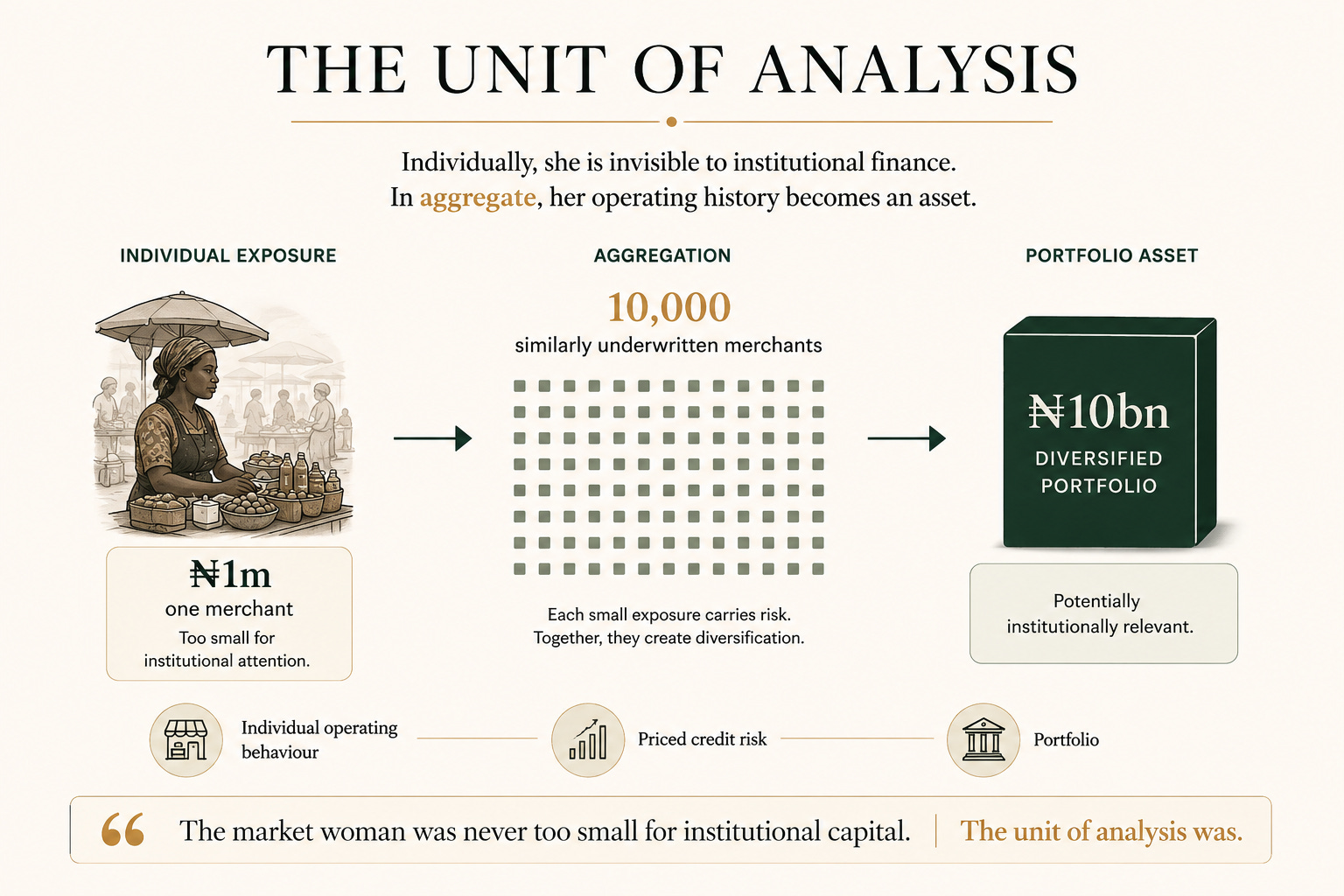
Consider an illustrative ₦1 million facility to one merchant. For a large institutional investor, that exposure is economically insignificant.
Now consider 10,000 similarly underwritten facilities.
That is a ₦10 billion portfolio.
The individual entrepreneur may be too small to justify institutional attention. A sufficiently large, diversified pool of exposures to entrepreneurs like her is a different financial object.
This changes how we should think about the fintech or payment platform originating the loans. The platform is not only a lender or distribution channel. It can also become a manufacturing engine for another financial asset: a diversified portfolio produced from thousands of individually small credit decisions.
The potential chain looks something like this:
merchant activity → behavioural data → underwriting → credit → repayment history → diversified receivables portfolio → warehouse funding → institutional takeout
Eventually, sufficiently mature portfolios might even support securitisation.
Nigeria is not there yet.
The country has a legal framework for securitisation and structured-finance precedents in other asset categories. But institutional-scale securitisation of alternative-data merchant and MSME credit remains underdeveloped.
The constraint is not simply capital.
Institutional investors need assets they can diligence, compare, monitor and price.
That requires consistent underwriting standards, several years of performance data across different economic conditions, predictable servicing, credible recovery processes, appropriate credit enhancement and legal structures capable of separating the portfolio from the financial condition of its originator.
Those functions are still developing.
India’s microfinance market provides one indication of where the path can lead. Granular loans to individually small borrowers have been aggregated into structured portfolios capable of attracting larger pools of capital. Nigeria’s market, regulatory environment and borrower characteristics are different, so the precedent does not establish that the same outcome will follow here. It establishes that individually tiny exposures do not have to remain institutionally irrelevant forever.
For decades, informal operators like her may have been generating commercially useful information that formal finance could barely process. Increasing digitisation means more of that information now has a format. Fintech underwriting can turn the format into a risk signal. Repeated lending can turn those signals into performance histories. At sufficient scale, those histories can begin to support portfolios that entirely different pools of capital can evaluate.
The first opportunity is therefore obvious: finance good informal businesses better.
The larger opportunity is to complete the financial machinery that allows thousands of those individually small exposures to be underwritten consistently, aggregated and eventually priced as one institutional asset.
Nigeria’s market woman may never have been too small for institutional capital.
The unit of analysis was.