

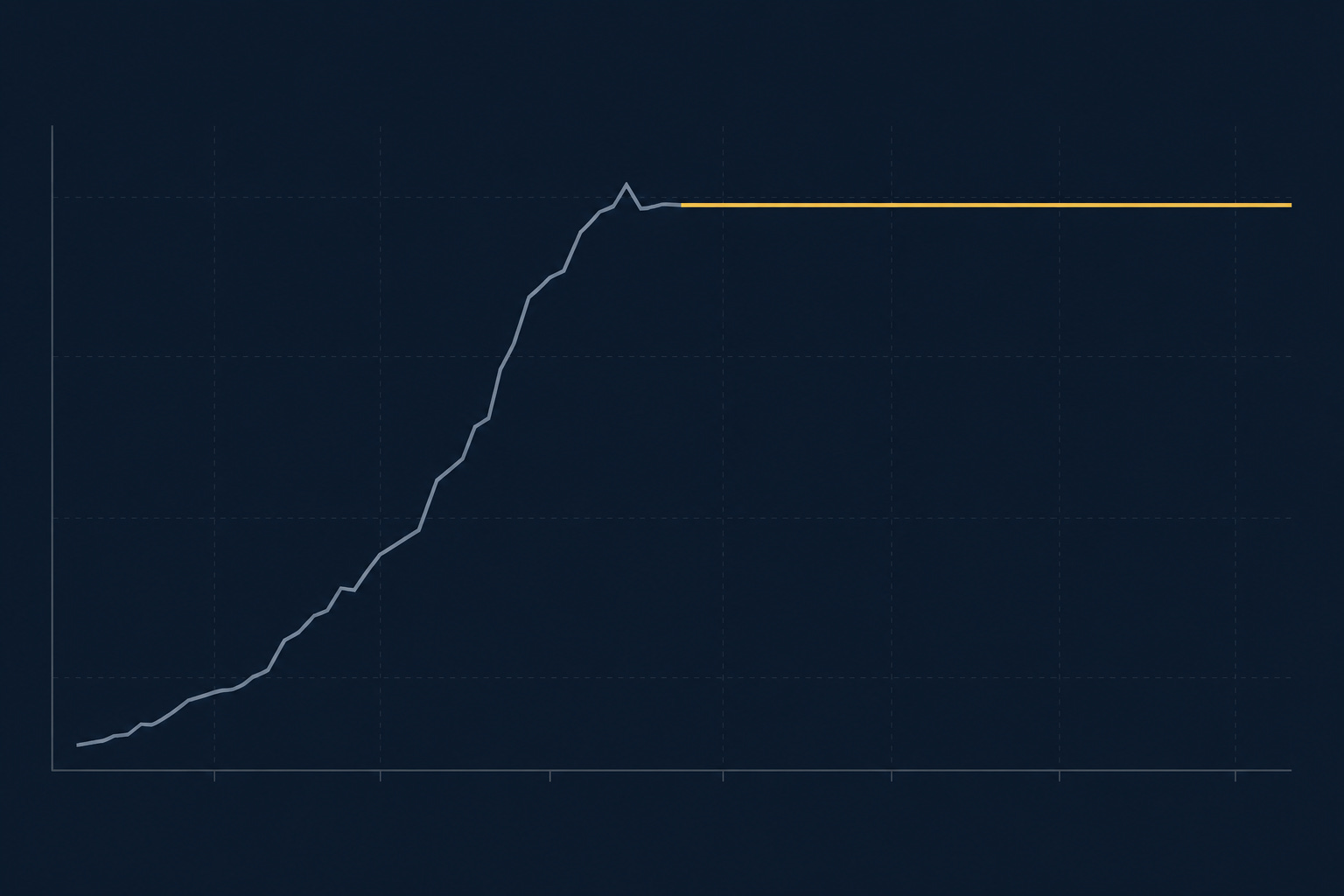
On Tuesday, Flutterwave announced a Series E. The headline number was $3.2 billion. Four years ago, in February 2022, the company raised $250 million at just over $3 billion. Do the arithmetic and the conclusion writes itself: flat. Maybe up a touch, depending on which outlet’s figure you use. Some say $3.2 billion. Bloomberg’s reporting puts it at $3.3 billion. Either way, one of Africa’s most valuable startups is still worth, four years later, almost exactly what it was worth in February 2022.
The crypto press covered this as a Ripple story, mostly. RLUSD landing on one of Africa’s largest payment rails, the XRP Ledger getting a live enterprise use case, the institutional case for stablecoins moving forward another notch. Read past the headline, though, and there’s a quieter story sitting underneath the valuation line that nobody seems to be asking about: Flutterwave just held a number it was priced at four years ago, through a global rate-hiking cycle, naira devaluation, and a continent-wide repricing of every 2021-22 vintage startup.
Is “flat” actually a good outcome, or the most interesting number in the entire announcement?
What We Called In January
In January, after Flutterwave’s all-stock acquisition of Mono, I wrote a forensic piece on this publication arguing that the all-stock structure was not strategic. It was arithmetic. Mono’s investors took Flutterwave shares instead of cash for a $25-40 million deal, and the reason, I argued, traced back to a cash position under pressure. Working from disclosed funding ($250 million raised in February 2022), a reconstructed burn rate, and the absence of any new round in four years, the model put Flutterwave’s runway at roughly ten months from January 2026. The company would need to raise by late 2026 at the latest, and likely had already started.
The size was wrong, and the reason it was wrong is worth more than the original guess would have been.
What the essay got right: the need, and the timing. Flutterwave was in raise mode. We now know that by April 2026, the company was deep enough into fundraising conversations that a Tinubu aide felt confident enough to publicly announce a $75 million government investment via the Ministry of Finance Incorporated, tied to a planned $250 million IPO. Flutterwave denied it — but the denial, read carefully, only disputed the $250 million IPO figure specifically. The company never addressed its broader relationship with the federal government, and Agboola had joined President Tinubu’s UK state delegation weeks earlier. Two months after that, the Series E closed. The runway pressure the January model predicted was real; the company was managing exactly the kind of capital-raising process the model anticipated, on roughly the timeline it anticipated.
What the essay got wrong: the magnitude. The January model assigned 60% probability to a down-round of 25-33%, landing somewhere around $2-2.5 billion. That was the central, highest-confidence scenario. It didn’t happen. Flutterwave priced flat to slightly up.
Why the Down-Round Didn’t Come
A markdown is not just a number. It’s an action that specific people have to take, and those people have incentives that a pure cash-flow model doesn’t capture.
Flutterwave’s existing investor base — Tiger Global, B Capital, Avenir Growth, and others from the 2021-22 rounds — are sitting on positions marked at or near $3 billion. A new round at $2 billion doesn’t just reprice Flutterwave. It forces every one of those funds to take a markdown on their own books, in their own LP reporting, in the same reporting cycle. Tiger Global, in particular, led both Flutterwave’s 2021 Series C and Mono’s 2021 Series A. A flat Flutterwave print protects two marks at once.
The January model gave this one line and moved on. It deserved the center of the analysis. A markdown requires someone with leverage over price to want it to happen, and in Flutterwave’s case, the people with the greatest incentive to avoid one were also among the stakeholders best positioned to help the company avoid it. That’s not fraud, and it’s not even unusual. It’s just how syndicates with overlapping cap tables behave when an existing portfolio company needs fresh capital. Defending a mark is what the relationship is built to do, the same way a bank’s credit committee is built to protect its existing loan book before it underwrites a new one.
The second piece worth separating out: not all capital prices the same way. The 2022 Series D was led by B Capital Group, a financial growth-equity investor, with a syndicate of seven additional named funds, full disclosure of round size ($250 million), and a publicly stated thesis about Flutterwave’s growth trajectory. That is what a priced, competitive, third-party-tested round looks like.
The Series E is a different animal. One named investor: Ripple. Agboola confirmed to TechCabal that it was “an actual cash investment” and that Ripple is “now an equity shareholder of the company,” so this is real primary equity, not a stock swap like Mono. But Agboola also told Bloomberg directly that he would not disclose the amount invested or the size of Ripple’s resulting stake. No lead financial investor. No syndicate. No round size. What’s disclosed is a strategic partnership: Ripple’s RLUSD stablecoin and the XRP Ledger get embedded into Flutterwave’s payment rails and remittance corridors.
A strategic infrastructure investor is not pricing the same thing a growth-equity fund prices. Ripple is buying distribution — a settlement rail across one of the largest payment networks in Africa, plus a stablecoin embedding deal that B Capital was never going to write a check for. When the thing being purchased is partly strategic access rather than a pure bet on enterprise value, the valuation attached to that access tells you less about fair market price than a syndicate-led round would. You can pay a premium for a relationship. You cannot easily pay a premium for nothing, which is what a financial investor, with no use for the rails, is implicitly checking when they price a deal.
Put those two things together. An existing syndicate with every incentive to avoid a markdown, and a single strategic check that was never required to compete for the deal. Neither proves the $3.2 billion is wrong. Together, they mean this round provides a weaker signal of market-clearing value than a competitive, disclosed, multi-investor round would.
What the Round Size Might Actually Be
Flutterwave hasn’t disclosed how much Ripple invested. We have one useful data point, even though it comes from an entirely separate, denied transaction. In April, reports surfaced that the Nigerian government, through the Ministry of Finance Incorporated, was preparing a $75 million investment as part of a $250 million IPO raise. Flutterwave denied that specific deal. The estimate that follows rests on a thin evidentiary base: the $75 million figure came from a transaction Flutterwave denied, with a different investor and likely a different rationale, and there’s no public evidence the Ripple check was sized anywhere near it. It’s simply the only externally reported reference point available for what kind of capital Flutterwave was discussing around this time, and it’s a reasonable floor for the Ripple check on that basis alone.
Ripple is a strategic infrastructure investor, not a financial investor maximizing ownership. Strategic checks of this kind, paired with a commercial integration rather than a pure capital play, tend to land at the lower end of what’s plausible, because the investor is optimizing for the partnership, not the stake. Working estimate: $100 million. Using Flutterwave’s own $3.2 billion figure as the post-money valuation (Bloomberg’s $3.3 billion would shave the resulting stake slightly smaller, not larger), that implies new investors taking roughly 3% of the company. A modest, controlled dilution event, consistent with a company managing its cap table rather than recapitalizing under pressure.
That estimate carries through to the runway picture as a single committed number, with the assumptions shown.
The January model assumed $3.5 million in average monthly burn, based on the deployment pace from 2022 onward. That assumption needs updating on two fronts. First, Agboola’s own H1 2025 letter stated that monthly margins had doubled compared to the 2024 average, attributing it explicitly to cost discipline. That’s a company-disclosed, sourced signal of real burn reduction, not a presumption. I’m using a 25% cut rather than taking “margins doubled” at face value, because a literal reading of that disclosure would imply a steeper reduction than 25%, and the more conservative figure avoids building the model’s most optimistic interpretation into the result. That brings baseline burn to roughly $2.6 million a month. Second, Mono adds its own cost: roughly $1.7 million a year, or about $140,000 a month, per the January estimate. Combined working burn rate: $2.75 million a month.
The January model put Flutterwave’s cash position at roughly $35.5 million as of January 2026. Five months of burn at the new, reduced rate brings that to roughly $22 million by the time the Series E closed in June. Add the $100 million raise: a post-close cash position of approximately $122 million.
At $122 million and $2.75 million a month, that’s just over 44 months of pure runway, into early 2030. But companies don’t wait until the tank is empty. The January model itself noted that companies typically begin fundraising with 12 to 18 months of runway still in hand, and Nigerian and African late-stage fintechs, operating with thinner banking relationships and slower DFI disbursement cycles than their Silicon Valley counterparts, tend to sit at the cautious end of that range rather than the aggressive one. Strip out a 15-month buffer and the next capital event, whether that’s an IPO or a Series F, lands around November 2028. Call it late 2028, roughly 29 months from the round that just closed.
That figure lines up with something else worth naming: 24 to 36 months between late-stage rounds is the normal cadence for a disciplined-growth fintech right now, a sharp change from the 12 to 18 month gaps that defined the 2021-22 boom. A bottom-up cash model and a top-down read of how the market currently prices capital events both land in the same place. That convergence is what makes the estimate worth stating outright instead of hiding inside a four-year range.
None of this is precision dressed up as fact. The $100 million is an estimate built on one denied government figure and a judgment about how strategic investors size their checks. The burn figure leans on a company disclosure that didn’t include hard numbers. Two assumptions stacked on top of each other will always carry more error than either alone. A stated assumption that can be argued with does more work than a range wide enough to be true regardless of what actually happens.
The Pattern, Not the Exception
This isn’t unique to Flutterwave. Across the continent, the type of capital funding startups has shifted hard in the same direction. African startups raised $705 million in Q1 2026. Debt, structured instruments, and strategic capital accounted for roughly $490 million of that, well over half. A year earlier, the split ran the other way, with priced equity taking the lion’s share. Whether it’s venture debt, a strategic partnership, or a single undisclosed equity check from an infrastructure player, the common thread is the same: capital that doesn’t have to clear the test a competitive, disclosed, financial-investor-led round clears.
Flutterwave isn’t an outlier in this pattern. It’s the largest, most visible example of it. The company everyone is watching, doing exactly what smaller, less-watched African fintechs and logistics startups have been doing in funding rounds all year.
What This Means for the Marks You’re Holding
If you’re a GP holding African fintech exposure from the 2021-22 vintage, the temptation right now is to point at Flutterwave and say: see, the sector held. Be careful with that read. A held headline number, sourced from a single undisclosed strategic check inside a syndicate with every reason to defend its own marks, tells you who was writing the check and why. It’s weaker evidence of what an uninvolved buyer, with no stablecoin rails to gain, would actually pay.
The practical implication: every “flat round” headline from here forward deserves the same three questions asked of this one. Who’s writing the check, and what do they get beyond equity? Is the round size disclosed, or only the resulting valuation? And who in the existing cap table benefits from the number landing exactly where it landed? A number that survives all three questions is a real signal. A number that doesn’t is a press release with good PR.
Flutterwave is not in trouble. Not in any way shoe or form. The product is real, the revenue is real and growing, and the Ripple partnership may well be strategically sound on its own terms. But “held its valuation” and “the market re-tested the price” are two different claims, and this round is much weaker evidence for the second one than the headline number implies.
The same forensic question shows up across every asset class I underwrite, including ones a long way from payments infrastructure. Is this cash flow legible, disclosed, and independently tested, or is it being managed around a number someone needs to hold? Music catalogs. Contract receivables. Royalty streams sitting on African artists’ balance sheets that look, on paper, exactly like Flutterwave’s GMV. Large, real, and almost impossible to lend against until someone is willing to disclose what’s actually inside the number.
It’s the same question, asked of a different balance sheet.